Tuesday, May 4, 2010
WILL BOSLEY & SNITCHLER DEBATE ON JUNE 17, 2010 AT THE NIMISHILLEN TWP HOSTED "STARK COUNTY TOWNSHIP TRUSTEES ASSOCIATION" MEETING?
Today is primary day in Ohio and Stark County. However, there are no primary contests in the Ohio House 50th District races (Republican & Democrat).
Notwithstanding the absence of primaries, the SCPR projects the 50th District face off in November between Republican incumbent Todd Snitchler and Democrat Todd Bosley to be the most important Ohio House race in all of Ohio.
Why is that?
Because the Republicans have a real chance to capture control of the House this fall and the Ohio Democratic Caucus knows it.
The Report believes the Democrats have known about the real possibility that they could be headed for minority status in the lower chamber for some time now and have been scouring all 99 districts to find opportunities to offset expected Democratic seat loses in November with take-aways from Republicans in order to maintain their majority.
That's why Ohio Speaker of the House Armond Budish showed up on the doorstep of Stark County commissioner Todd Bosley in January, 2010.
Democratic caucus polling had shown that Bosley was a strong candidate to unseat Republican Snitchler. So Bosley was going to be the Democratic candidate.
But wait a minute. The slot was already spoken for. Realtor Jeffrey Ury of Lake Township (also Snitchler's home) had already taken out petitions. And he was not of a mind to step aside.
Well, the Caucus (believing Bosley to be a much formidable candidate) was not about to let this inconvenience to get in its way. The Report believes that the Caucus induced Ury to step aside.
Ury is now set to be a a Caucus-employed regional director for Democratic candidates. His region includes the Bosley/Snitchler race. The Report has also been told that Ury was being heavily considered to be Bosley's campaign manager until such was squelched by House Caucus director Liz Brown (daughter of U.S. Senator Sherrod Brown).
Ury did confirm the former but denied the latter.
Nevertheless The Report continues to believe that Ury being Bosley's campaign manager was Bosley's carrot to Ury to get him out of the primary only to have the idea vetoed by Brown.
Moreover, Ury made it clear to the SCPR that he had not approached the Caucus for the regional directorship. Rather, he says, it was the Caucus had approached him. He also denied that it had anything whatsoever to do with his getting out of the primary.
This Bosley/Ury chain of events is reminiscent the Snitchler/Tina Hagan tiff (daughter of term limited out - the 50th - Republican state Representative John Hagan) pre-primary 2008. Hagan claimed she was approached by the Ohio Republican Party with an inducement to bow out of the primary against Snitchler. However, she refused to do so.
Snitchler handily defeated her, but sources tell the SCPR that former Rep. Hagan supported Snitchler opponent Democrat Celeste Dehoff in the November general election whom Snitchler defeated by nearly 20 percentage points.
Ury, of course, given the directorship will be supporting Bosley. And there is Ury's direct statement of Bosley support given to The Report.
Signs that others in Stark County sense The Report's take on the crucial importance of the Bosley/Snitchler match up is evident in an invitation issued the duo by the Nimishillen Townhship trustees who are hosting the Stark County Trustee Association's monthly meeting on June 17th.
Invitation to do what?
Debate, that is what!
Here is a copy of the invitation:
Isn't June a little early?
It is. But in this race with its statewide ramifications, campaign normalcy and tradition (campaigns debates usually do not occur until - at the very earliest - until September) will not apply.
Both candidates are working at a fever pitch already. Snitchler has quite a few signs out for the primary and is making quite a few appearances throughout the 50th. Bosley is doing heavy door-to-door and fundraising and being a very visible commissioner.
So buckle up Stark Countians, the Bosley/Snitchler political fireworks are about to burst onto the local political scene.
Though the 50th only includes about one-third of Stark County, the outcome is of enormous importance to all of Stark County and, indeed, the state of Ohio!
DOES PRESIDENT BARACK OBAMA HAVE ANY PERSUASIVE POWER WITH STARK COUNTY BOARD OF ELECTIONS MEMBER JOHNNIE A. MAIER, JR.?
Maier came back to Stark County absolutely starstruck on the 42nd president who served from 1993 through 2001.
The SCPR is hoping that Maier is consistent on being enamored of Democratic presidents and is also
starstruck with President Barack Obama.
Why's that?
Because Obama just came out with a presidential directive on transparency and open government.
So?
Well, the SCPR has been trying to nudge the Stark County Board of Elections (BOE) into using its fancy new copy/scanning machine (on which the BOE took delivery in January) to enhance the Stark County public's access to public information online.
No success, so far.
In an April 12, 2010 e-mail to Director Jeannette Mullane (BOE), yours truly asked for a copy of the "draft" videotaping of board meetings standards and also for an update on the status of The Report's request that the BOE begin scanning in candidate petitions filed and local candidate finance reports filed.
Originally, The Report made the request last fall. However, the BOE members have refused to put the request on their agenda for consideration formally made back in February.
Mullane, in response to the SCPR e-mail, did provide the requested draft, but was SILENT on the asked for status report on the scanning.
The SCPR just loves it when public officials answer what they want and just ignore what they do not wish to deal with. Kind of a strange position for a "public" official, no?
And these folks wonder why voters think twice, three or four times about voting for county tax issues? Hmm?
Back to Obama and Maier.
As the SCPR sees the situation at the Stark BOE, Democrat Maier is the de facto chairman. Republican William Cline is the de jure chairman
Not only is Maier, in the opinion of the SCPR, the de facto chairman, The Report believes that - internally at the BOE all eyes are on him - as to how the BOE should run its operations. His only resistance from Republican members Cline and Braden (former Stark County Republican Party chairman) seem to be on partisan Republican/Democratic issues.
To repeat so as to underscore, The Report's take is that Maier runs the show at the BOE.
This is where Obama comes in.
On his Transparency and Open Government website, President Obama has this to say on a topic that The Report thinks bears on yours truly's tiff with Maier and the Stark BOE, to wit:
Government should be transparent. Transparency promotes accountability and provides information for citizens about what their Government is doing. Information maintained by the Federal Government is a national asset. My Administration will take appropriate action, consistent with law and policy, to disclose information rapidly in forms that the public can readily find and use. Executive departments and agencies should harness new technologies to put information about their operations and decisions online and readily available to the public. Executive departments and agencies should also solicit public feedback to identify information of greatest use to the public. (text font changed and bolding done for emphasis)Now if consummate Stark County Democrat Maier is starstruck (let's hope he is) with Democrat Obama, he could honor Obama's wisdom and wishes with regard to easy public access to government by prevailing on his fellows who make up the BOE to issue its own directive to Director Mullane, to wit:
Implement the request!
But will the BOE?
Probably in time. And this is a terrific opportunity in terms of timing for Maier to take the lead.
Surely, Democrat to Democrat standing up for more democratic access for the information in the hands of local government is a way for Maier to honor his Democratic president.
Labels:
Stark Board of Elections
Monday, May 3, 2010
POINT & COUNTERPOINT IN THE NWLSD LEVY FIGHT. BUT THE REAL ISSUE IS WHETHER OR NOT THE NW BOARD HAS MADE SUFFICIENT PROGRESS ON THE RE-BUILDING OF TRUST, ISN'T IT?
The most candid person on the
Northwest Local Board of Education (Board) is board member Jim
Gindlesberger.
In August, 2009 he correctly identified the Northwest dilemma in getting a levy passed. His observation was:
"The trust issue is huge. It's something that we may not even correct by May. We are not one community. We are two communities and we have to fix that."The bad news is that once trust is lost, it is merely a matter of time until a relationship is a matter of time.
The good news is that once the loss of trust is squared up with, reconstructive and restorative measures can be implemented to get back to a similitude of the former trust.
However, now-a-days restoring trust is an uphill battle magnified. And re-building trust is permanent process. It is never completed. If trust building efforts are ever abandoned then distrust come rushing in as a torrent.
A recent national poll shows that only about 20% of American trust governments at all levels. This is a flip from what the 20% was in the 1950s. In the 50s the 20% was the number who did NOT trust government.
As soon as it dawned on Northwest school officials that the failure of trust was the core problem in getting sorely needed local revenues passed by Northwest voters, it appears to the SCPR that they did go to work on an emergency program to restore trust.
But the problem with a panic program to restore trust (or, if you will: "a quick fix"), is that any measure taken is viewed by some as being insincere and designed just to get the levy passed. Too many times the skeptical view has proved to be accurate.
Gindlesberger's statement on the gravity of the trust problem in Northwest did not go far enough.
The problem is more than a Summit County (New Franklin and Clinton) problem. Obviously, many Summit County constituents feel they are the outsiders in the Northwest district. When the Board had several opportunities to bring a New Franklin or Clinton member onto the Board when board slots opened up; they failed to. Accordingly, the Summit County constituents likely feel that they still are not embraced by district officials.
Other distrust generating problems include the bus garage purchase, the water line extension (without considering drilling its own well system) , the conversion of inside millage to meet Northwest's share of Ohio Schools Facilities Commission monies (about $1 million) and other lesser but cumulative slights of Northwest constituents which build - over time and repetition - into festering sores of generalized distrust.
Moreover, the very structure of the earned income tax effort suggests a pitting of working people against the retired. One of the big efforts of the vote yes folks is to senior citizens, many of whom have no earned income but only tax exempt retirement and investment income.
As a parenthetical, this approach may not be the panacea of getting seniors to vote for the levy as school officials apparently think. A mushrooming reality is that many senior citizens are returning to the "earned income" workforce out of necessity. Years of inflation have taken their toll on viability of pensions to sustain recipients. Also, escalating heath care deductibles erode pension income even more.
In recent days another developing garden of distrust is a revelation that the 1% earned income tax issue (Issue 7) "Save Tomorrow" committee is 70% percent or better financed employees of the school district. Employees who may be asking for wage increases when contract negotiations are taken up next year.
Already, a number of voters are asking: "Is this really about preserving the Northwest school system for the kids or is it about preserving the jobs and lifestyles of a relative few?"
A question like this only surfaces in the volume and frequency that one hears it in Northwest in an atmosphere of significant distrust.
Even those who opt to vote for the tax will be closely watching school officials and union representatives in 2011 (assuming the issue passes) to see whether or not their decision to "trust" for purposes of Issue 7 were merited.
The big danger for Northwest officials lies in the passage of Issue 7.
Will it be back to business as it was in the years of levy failures?
As The Report writes, talk is circulating that Ohio could be cutting local school districts by as much as 30%. One high level county education official is saying that if the 30% cuts materialize, Stark County schools will be finished unless they can make the money up with local levies.
A 30% cut in Northwest state funding likely means that the 1% earned income tax revenues will not last the projected 5 years. And Northwest is likely to be back with an additional levy request in the interim, especially if district employees get a pay increase in the 2011 negotiations.
It could be that not even a "pay freeze" in 2011 will do. It may take pay cuts, if Northwest is to maintain its staff at current levels. If salary cuts are what the financial condition of the Northwest schools call for, then can Northwest voters trust the administration and the bargaining unit to put the subject on the negotiating table?
The upshot of the foregoing analysis is that even if the earned income tax passes, Northwest school officials must ramp up exponentially the effort to re-build community wide trust or this will be the last levy they pass in a very, very long time!
Labels:
Northwest Board of Education
Sunday, May 2, 2010
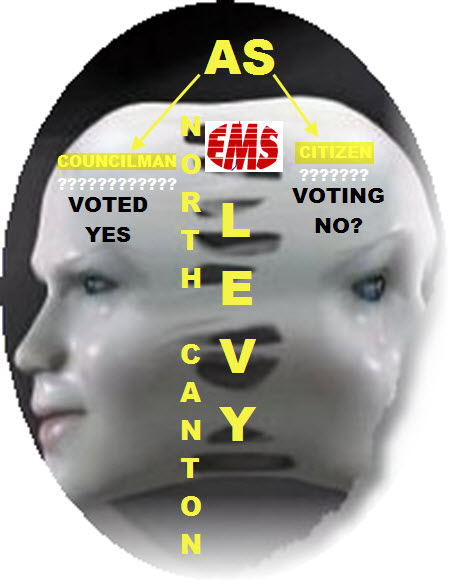
NORTH CANTON MAYOR DAVID HELD TELLS SCPR THAT TWO LEVIES WILL PASS WITH OR WITHOUT THE VOTE OF A NORTH CITY COUNCILMAN. HMM?
Next Tuesday (May 4th) North Canton voters will be deciding whether or not to pass a couple of levy requests.
The strange thing about this election is that a North Canton councilman is telling some North Canton folks that he will not vote for the EMS levy.
However, he did vote to put the levy on the ballot for the rest of the North Canton electorate to vote up or down on the issue.
Who is this councilman?
None of the SCPR's three sources will name the councilman.
Apparently this is a classic case of political "do as say, do not do as I do." Or is it? Does this councilman hope that voters will vote the levy down? How much is he privately campaigning against the levy?
Nobody seems to know.
Why is the mystery councilman opposed anyway?
Council president Daryl Revoldt says that it "probably" is because the councilman thinks that the cost to North Canton of running an EMS service has gotten totally out of hand and believes if voters reject the levy EMS will go belly up and then North Canton can reconstruct an EMS in a more fiscally responsible manner.
One example given by the council (according to a source - not Revoldt) is the assertion that an EMS worker made $95,000 in 2009. Presumably, this happened - if it did - because of overtime paid.
The 1.5 mills EMS levy is to run two years. Revoldt and Mayor David Held that they are optimistic that this levy and a 1.0 mill road levy will pass.
On the EMS levy they point to a community survey completed by 19% of the North Canton public which gives the City high marks for its EMS services. Revoldt says that he is confident that EMS will pass because the decision to put the issue on the ballot was "market driven." In other words, citizens will support with taxes those functions of government that the public perceives to be "value added."
The road levy may be a "different kettle of fish." It failed by about 10 votes in November, 2009.
However, Mayor David Held is optimistic about its prospects for passage this time around. He says that the only reason that the 2009 effort failed was because there was new money in the levy. Held uses the deletion of the new money from the levy as a example of and proof of how North Canton government listens its citizens.
The SCPR believes that North Canton government is more and more in the listening mode vis-a-vis its people.
If so, the future of North Canton could be tracking into positive territory.
Saturday, May 1, 2010
BOSLEY: OHIO HOUSE 50TH RACE - 2010 PRE-PRIMARY CONTRIBUTIONS BY NAME, CITY, AMOUNT, EMPLOYER & OCCUPATION
SOURCE: OHIO SECRETARY OF STATE (REDACTED FROM FULL REPORT BY THE STARK COUNTY POLITICAL REPORT)
SNITCHLER: OHIO HOUSE 50TH - 2010 PRE-PRIMARY CONTRIBUTIONS BY NAME, CITY, AMOUNT, EMPLOYER & OCCUPATION
SOURCE: OHIO SECRETARY OF STATE (REDACTED FROM FULL REPORT BY THE STARK COUNTY POLITICAL REPORT)
CONTROVERSY SWIRLS AROUND STARK COUNTY COMMISSIONER DOG WARDEN SELECTION PROCESS?
UPDATE: 05/01/2010 - 11:00 AM
Hi Martin,
Thank you for thoroughly and objectively covering the dog warden issue. It seems that the more things change, the more they stay the same. I am in agreement with the Advisory Board that a "breeder," someone who makes money by producing and selling dogs for profit is hardly a prime candidate for an agency whose job it is to deal with too many dogs, not enough homes.
Ironically, I have heard from several sources that candidate Chapman would be an outstanding choice in the effort to transform the Pound into a model facility. While I am not on the Advisory Board I did contact Todd Bosley stating the reasons I felt an outsider, someone with no County "obligations" would be advantageous. I have not had a reply, but after reading about this latest clandestine meeting, excluding the very people who work tirelessly to improve the Pound, costing tax payers not one bloody nickle it seems once again that something is fishy.
Like I said, the more things change, the more they stay the same.
Karen L. Kirsch
Freelance Writer
Freelance Writer
ORIGINAL REVISED at 8:45 AM
On Tuesday, April 27, 2010 Steve Swank, a member of the Stark County Dog Pound Advisory Board appeared at the Stark County Commissioners office to participate in interviews that commissioners were conducting to hire a new county dog warden.
To his amazement, according to Swank, he was told by County Administrator Mike Hanke that he would not be allowed to participate.
Amazement?
Yes, amazement!
Why so?
Because back on April 7th, when Swank appeared before the commissioners to announce the recommendations of the Stark County Dog Pound Advisory Board (DPAB), the following exchange occurred, to wit:
Board members are indignant that Swank was excluded. Here is the contents of an e-mail sent to the commissioners and to Administrator Hanke expressing their upset, to wit:
Dear Commissioners and Mr. Hanke
Members of the Stark Dog Warden Advisory Board were pleased to have the opportunity to review all the applications for the new dog warden position. With regards to all the facets this job entails, such as good management practices, dealing with labor unions and volunteers, budgeting, public relations , knowledge of basic dog handling, temperament and health issues, etc. , we carefully selected our top applicants from the 127 submissions.
All of us on the Board know we are not making the final decision; however we were shocked and angered to learn at the last minute - contrary to what we were previously told - that a representative from the Board would not be welcome during the final interview process. After almost two years of dealing with Warden Gibson's indifference to almost all of our suggestions , it is extremely frustrating to realize that all the time and dedication the Advisory Board has spent trying to make the Stark Dog Pound a model for other pounds to follow and our community to be proud of, is likewise being disregarded by our commissioners. (emphasis added)
Stark County Dog Warden Advisory Board
Len Cooper, President
Steve Swank, Vice President
Nanci Miller, Secretary
Rosemary Hayne
Dana Muntean
Sally Roush
So what changed to cause Swank to be excluded?
It could be that a person was added to the list (hereinafter referred to as "lady" as identified by County Administrator Mike Hanke in an e-mail to DPAB president Len Cooper as set forth below) of those to be interviewed that was NOT on the top ten list of any of the DPAB members.
And what was a prime reason why the lady was not on anyone's top ten list? Two of the members told the SCPR, it was because the "lady" has a history of dog breeding.
The thinking of DPAB members seems to be that being a breeder is antithetical to being a dog pound warden.
How so?
One DPAB member told the SCPR that breeders get litters that have only a few (from the perspective of the breeder) "good" dogs in terms of saleability. The remainder are cast aside and a number of them end up in dog pounds to be adopted out, if possible; if not, then euthanized.
Accordingly, the SCPR believes one reason that Swank and fellow DPAB member Cooper who was to be part of the Thursday, April 29th interviews were excluded may be because the commissioners perceived both to be set against dog breeders as viable candidates for dog warden.
Another reason why Swank/Cooper were kept out of the interview process could be because the suspicion of one DPAB member that the commissioners have a political agenda to appoint the "lady" and that the other three candidates are a charade to cover for a political agenda candidate.
Because yours truly knew, from previous conversations with him on, what seems to be, unrelated matters, that Commissioner Bosley has had contact recently with the lady's spouse, inquiry was made of Bosley as to whether or not those contacts had anything to do with the lady surfacing as a finalist for the warden job.
Bosley said they did not. However, yours truly is skeptical and told Bosley so.
After saying that he did not know how the "lady" ended up on the "final four" list (who would believe this disclaimer?), Bosley referred The Report to County Administrator Mike Hanke for information on how the lady got on the list.
Moreover, Bosley did say, however, that the "lady" is number one or two oh his list - post interview. Apparently, it was one heck of an interview, no?
The Report is also struck with the disingenuous way that The Report believes County Administrator Mike Hanke handled yours truly's inquiries as to how the "lady" got on the final four list despite not being on the top ten list of any DPAB member. The exchange of e-mails between the SCPR and Hanke is set forth below.
Disingenuous?
How so?
First, take a look at a SCPR and Hanke e-mail exchange.
Second, about three hours later, see what Mike Hanke wrote to Len Cooper (president of the DPAB) yesterday at 2:19 p.m.
Hi, Len:
I understand your concern, but perhaps you didn't know that a couple of the commissioners talked to this lady before they asked the advisory board to review resumes. She impressed them then. Frankly, they were surprised that she wasn't among the advisory group's recommendations. (emphasis added)
The commissioners said to me that they really would like to interview her and compare her to the group's recommendations, and I recommended to them that they add her name to the list. This is not precedent setting.
In previous hiring situations, commissioners have interviewed candidates in addition to lists given to them by groups that screened resumes.The second e-mail was after Commissioner Bosley had spoken with Hanke about the matter.
Certainly the board highly values the recommendations from its advisory group but, as you note, ultimately they must hire the individual and they must consider some important areas, not the least of which are how the new warden interacts with commissioners, how he or she interacts with the public -- including those calling about problem dogs in neighborhoods -- and how he or she will react to situations as a law enforcement officer.
Len, I don't think the commissioners took your list of recommended candidates as a recommendation against all other candidates. We looked at it as the group's recommendation of its top five.
As it turns out, two of them didn't schedule interviews. I also await with interest the hiring, although nothing has been scheduled for next Wednesday.
Thanks,
Mike
More forthcoming, but not entirely.
The SCPR is beginning to see indications that Mike Hanke may be singling out The Report for "special" treatment in a negative way as compared to the employees of his former employer - The Repository.
The Report reminds Mr. Hanke that he is no longer at The Repository, but rather an "appointed" public official. Yours truly will not tolerate discriminatory treatment and will make a very public battle of any effort by Hanke to treat the Stark County Political Report disrespectfully.
Now back to Hanke's "lame points" (remember, a man who wouldn't want to put words in the mouths of commissioners):
First, consider: "... perhaps you didn't know that a couple of commissioners talked to this lady before they asked the advisory board to review the resumes ..."
Really? Which two commissioners? What was the occasion for the conversations? Were the two commissioners together when the "talked to" occurred? If separate, when did the two different conversations take place? And, if separate, did the two commissioners compare notes prior to the actual interview?
Of course, Administrator Hanke doesn't go into the intricate implications of what he has to say. Why not? Perhaps because "[he] wouldn't want to put words in the commissioners (sic) mouths."
Second, consider: "Frankly, they were surprised that she wasn't among the advisory group's recommendations."
Surprised? Really? What jumped out about the lady that was so riveting to the commissioners?
The Report's review of the lady's resume shows (other than owning and breeding dogs) that since 2003 she has worked in a collections department and as a real property manager. From September, 1984 through November, 2003, she was office manager and secretary/treasurer of an animal hospital.
Why would anyone be surprised that such a resume would not be compelling to a group of advisers who currently work with dogs (and have historically worked with dogs) in various capacities for quite a few years?
Hmm?
If anything, the Hanke letter lends credence to the notion that the commissioners had pretty much made their minds up some time ago.
Now it appears to The Report they may be building a justification for a hire that doesn't seem to make sense.
Readers will recall that the SCPR has never bought Bosley's account of how former Commissioner Tom Harmon's stepson came be named deputy dog warden several months back.
Nor does The Report buy the official line on how the "lady" found a way to jettison from relative anonymity to "the final four."
Soon county commissioners will be deciding whether or not to put a tax issue on November's ballot.
The SCPR believes that the county is in genuine need of new revenues.
However, when the commissioner allow procedures like the dog pound warden selection to get shrouded in inexplicable, suspicious and Byzantine maneuvers, then "seeds of distrust" get sown and when teamed up with previous such incidents, the chances of getting the voting public to vote for tax increases or even renewals plummet.
Only about 20% of Americans trust government these days.
It is becoming readily apparent to the SCPR why trust is taking a nosedive.
What is crazy about this phenomenon of growing distrust is this.
Who would want to govern in a atmosphere of overwhelming distrust?
Subscribe to:
Posts (Atom)