Monday, June 9, 2014

VOLUME 8 (SCPR SERIES) GENDER DISCRIMINATION IN STARK COUNTY?


UPDATE:  2:00 PM
(2004 REGIONAL PLANNING EXECUTIVE COMMITTEE)


The Stark County Political Report began a new series focusing on gender (equal pay for equal work) seven weeks ago with Volume 1 with an examination of "the commissioners office," "the Stark County treasury" and "the recorder's office."

Six weeks ago  in Volume 2 the perusal was of the county auditor's and prosecutor's office.

Five weeks ago (Volume 3 in this ongoing series) the look was at the clerk of courts office and the Stark County sheriff department.

Four weeks ago  (Volume 4) the SCPR examined the Stark County Engineer's office and the Stark County coroner's office.

So far The Report has been less than impressed (in an overall sense) of how Stark County's elected officials are doing on the matter of gender equity. 

And that experience squares up with the state and federal governments.

A primary document to be familiar with for anyone who cares whether or not American women are treated equally in the job market is in the Equal Pay Act of 1963.  However, the fight for fairness for more than half the American population continues inasmuch as the fact of the matter is that the 1963 act has not resulted in pay equity for women.


Of course, the law is one thing.

The underlying facts of the rampant discrimination and hardship that American women from the early 1600s on have had to endure and thereby necessitating the 1963 law is something that we all should familiarize ourselves with.

The SCPR recently completed reading Gail Collins' America's Women and recommends that readers of this blog series take time to read.

Anyone who thinks that our great nation has overcome this blight, needs to think again.

In 2009, population demographics showed that women outnumbered men 158.6 million to 151.4 million.  And there is no reason that the tilt to a distinct majority women is not growing.

One danger in citing national statistics is that you, I and our neighbors might think that here in "good ole Stark County" there is very little if any gender employment discrimination going on.

Already, the SCPR believes that this blog's series is showing that the fact of the matter is that there are pockets of real and substantial differences in how men are paid depending on what department of Stark County government one is looking at.

Of course, the only place that information is readily available to assess is in government.  There is no right to obtain data from the "private sector" as to what the pay scales are between males/females as there is in the public sector. Accordingly, we have no choice but to rely on national statistical studies to get a feel for what is going on locally among privately owned entities.  And there is no reason to believe that the Stark County private sector varies significantly from the national scene.

As far as Stark County is concerned the blog of three (3) weeks ago (i.e. the Court of Common Pleas, Family Court and the Public Defender's departments of Stark County government) showed complete turnaround from Volumes 1, 2, 3 and 4 in terms of women getting equal treatment in terms of pay and position.

But the blog of two (2) weeks ago (9-1-1 EMA, the Stark County Board of Elections and the Veterans Service Commissioner) showed a reversion to a indication that women are not by and large seeming to get equal pay/opportunity in county employment.


The trend line continues with this week's blog that deals with:
  • Regional Planning,
  • Sanitary Engineering, and
  • Stark Parks
REGIONAL PLANNING


Does this chart (blue contrasted to pink) show any apparent gender bias in terms of pay and opportunity equality?

The Stark County Political Report thinks so.

Notice how many Stark County departments have males as department heads as compared to women?

And the Regional planning department falls right into line with the predominant trend.


 (LINK to list of "all" members of RPC)

Robert Nau (former Louisville city manager) does have an "adjusted 'for PERS?' service date" going back to 1988 but he actually became director on March 8, 2004.   Note that Elizabeth "Beth" Pearson goes all the way back to January 18, 1978 in terms of hiring into Regional Planning.

But Nau makes $22,000 plus more than Pearson.

Also, look and compare the service dates of Brenda Sarsany and Lynn Carlone.

They pre-date Underwood and Dutton and yet Underwood and Dutton are paid
  • Underwood [service date 1995] compared to Carlone [1987] - $36,000, and
  • Dutton [service date 1996] compared to Sarsany [1991] - nearly $27,000
substantially more.

As to the matter of having an opportunity for promotion when Nau's predecessor Gerald Bixler retired (2004), why wasn't Carlone or Pearson in line to get the top job?


The SCPR spends a lot of time covering the Stark County commissioners' weekly meetings and frequent visitors who bring with them their expertise on regional planning matters are Ms. Pearson and Ms. Carlone.

Nau does show up on occasion, but The Report gets the impression that the likes of Pearson and Carlone are the heart and soul of the Stark County Regional Planning operation.

SANITARY ENGINEERS


All one can say is that "engineering" - apparently, of any variety, is far and away "a man's world."

And the payroll of the Stark County Sanitary Engineering office presents nothing whatsoever to dispel that notion as being in full force in Stark County.

STARK PARKS


The Stark Parks continues the "top heavy - male" employment pattern (in terms of pay and promotional opportunity) that is so prevalent in Stark County government - taxpayer supported; both males and female tax payers, of course!


An non-gender factor to look at moreover is the double entry that the SCPR includes on Robert Fonte.

Pay attention to the adjusted service dates.

Fonte's latest is March 1, 2013 as compared to a prior payroll report which shows December 16, 1982.

What does this mean?

Fonte is a "retire-rehire," so it appears.

And did Stark County taxpayers get a break on his retire-rehire salary.

Not according to the Stark County auditor's office data that the SCPR is using in doing this series of blogs.

Exactly the same before/after retire and rehire:  $103, 343.95.

What on the Stark Parks board is looking out for Stark County taxpayers?

Note that Barbara Wells and Daniel George are paid some $33,000 per year less than Fonte.

Wow!

Is it a question of them being paid appropriately or Fonte being way over paid?

The SCPR opts for the latter over the former.

Friday, June 6, 2014

(VIDEOS) STARK DEMS PUT "HAPPY FACE" ON GONZALEZ YEARS AS CHAIRMAN


 UPDATED AT 1:00 PM (REVISED & ADDITIONAL COMMENTARY)

No doubt it is politically incorrect (as far as Stark County Democratic Party officialdom is concerned) not to get in line with all the King's Horsemen and the King's Men in an effort to put Humpty Dumpty back together again.

True to form, the Stark County Political Report is not about to say that Randy Gonzalez's reign as Stark County Democratic Party (Party) chairman was a success.

However, as The Report nearly always does, this blog will let those who differ have their say.  Accordingly, the SCPR has included in this blog Gonzalez's self appraisal, the remarks of various other leading Stark County Democrats and the presentation of new party chairman Phil Giavasis make their own case.

The truth of the matter, as The Report sees it, is that Gonzalez's five years plus as party chairman has not been a success for the Party and much more importantly has,  to say the least, been a trying time for the citizenry of Stark County which likely has resulted in an overall subtle decline of the public's confidence in the institutions of local government.

The Stark County commissioners' office (Democrat Thomas Bernabei and Republican Janet Creighton, in the main) have been the only force in local government that has performed since 2011 in a fashion to undo the damage (which did not materialize until 2009) some think was put in motion when the Stark Dems' (ironically, in 1999 under the chairmanship of now Stark County prosecutor John Ferrero) appointed  one Gary D. Zeigler as Stark County treasurer.

In his day, Zelgler's primarily qualification to be appointed treasurer seemed to be his persistent and enduring work on behalf of the Party's causes and his carrying the Party banner in "sacrificial lamb" sorts of  multiple tries for political office of the 1990s.

Moreover, when Gonzalez became chairman Stark's organized Democrats held all non-judicial countywide offices.

In the 2010 elections, the Dems lost the treasury and the auditor's office.  While Zeigler was restored to office in August, 2011 by the Ohio Supreme Court because the pre-election-of-2010 Board of Stark County commissioners (Democrats Bosley, Ferguson and Gonzalez confidant Steven Meeks) had unconstitutionally removed him as a consequence of what local attorney ancd civic activist Craig Conley has termed as being Zeiglergate, it was clear to one and all that Alliance Republican Alex Zumbar (who won the 2010 treasury election which the Supreme Court invalidated) would have to because of public demand be appointed by the Democrats. 

Last night's Dems' meeting was in celebration of Party loyalists.  That is to say, those loyal to the political machine built up over time (going back to the late 1980s) by Johnnie A. Maier, Jr of Massillon.  But, of course no direct mention of Zeigler was made.  (for those readers unfamiliar with Zeigler's time in office, here is a LINK to get up to speed with).

The - sore point - oblique reference to the Zeigler years in office was made by Chairman Gonzalez last night as he recalled and described how he had to lead the fight within the Party to appoint  Zumbar to replace Zeigler when Zeigler resigned/retired on October 19, 2011.

Zumbar in the November, 2012 general election easily defeated the token Democratic candidate put up to oppose him.

Gonzalez as he is prone to do (a la the Democrat's very best political spin artist; i.e. Canton mayor William J. Healy, II) put the best face on the unpleasantness of appointing Zumbar.

However, a number of "official family Democrats" are still upset that Gonzalez caved in to public pressure.

To be sure, the Democrats still have a tight grip on most non-judicial countywide office.  The fear now is that they could lose the sheriff's office come November.

At least some of Stark's organized Democrats are concerned.  Others may just as soon see Republican Larry Dordea's election.

These may include those who did not support either in February or December, the selection of George T. Maier to be the Party's appointed sheriff.

If George is elected, then the Maier faction of the Stark County Democratic Party (the controlling faction) will have achieved its deepest reach into Stark County government.

Though not nearly inclusively enough, here is a graphic created by the SCPR to give a semblance of the Maiers' reach into Stark County officialdom government.


And most of them were main players in last night's gathering.

The machine itself was rocked on February 5, 2013 when Junior's brother George T. Maier narrowly defeated the politically unknown and unsophisticated Louis Darrow for the Stark County Democratic Party Central Committee's  (SCDP-CC) appointment as Stark County sheriff (LINK to circumstances and background of the appointment for the unfamiliar).

Everybody was stunned when Maier had to fight hard to eke out a narrow 92 to 84 over political novice Darrow.

It remains to be seen as to whether or not the George T. Maier appointment will stick.

It is one thing for him to have navigated the waters created by brother Johnnie over nearly 30 years of politiking, but it quite another to have to get the endorsement of Stark County voters in an election year that without a doubt is going to be a banner year for Ohio Republicans.

If Republican John Kasich runs as well as the SCPR and many other political analysts think he will, it will be difficult indeed for George T. Maier to win election even if (as the SCPR expects he will) runs well ahead of other Democrats running this election year in Stark County.

And it was obvious from the remarks of the Maier controlled Stark County Democratic Party officialdom that though there may be other Democratic Party candidates on the November 4, 2014 ballot; nearly all the local Party's resources are going to be dedicated to the George T. Maier effort.

The SCPR dubs the Maier/Dordea (Republican Larry Dodea, former Alliance police chief and current Hartville police chief) as "Dordea's to lose."

"Dordea's to lose" in the context of the "up-ticket" drubbing that the Democrats are likely to take in the November election is the SCPR's take on the November Stark County sheriff races match up.

If this were 2016, the tables would be reversed and Maier would be the odds-on-choice to win.  For Democratic political organizations can only seem to get the Democratic base out in big enough numbers in presidential years. 

If Maier is to win, then new chairman Phil Giavasis (Democrat; currently Canton Municipal Court clerk of courts, formerly Stark County clerk of courts) will have to demonstrate tremendous leadership skills in terms of bringing a divided political party together.

In any event, whether Maier wins or loses, Giavasis, the SCPR assesses, is only a "temporary" chairman.  The chairman-in-waiting, The Report is convinced is Randy Gonzalez's son Kody who succeeded father Randy as chief deputy clerk of courts under guess who?

You've got it:  Canton Municipal Court clerk of courts Phil Giavasis.

As promised, here is a series of videos the SCPR took of last night of the "Maier Loyalty Club" rally.

SCDP-CC SWEARING IN & GONZALEZ FAREWELL
OKEY APPOINTED TEMPORARY CHAIR


GIAVASIS NOMINATED/ELECTED AS NEW CHAIR
NOMINATOR: CRAIG CHESSLER, PERRY TWP TRUSTEE


NEW CHAIRMAN GIAVASIS TAKES CARE OF BUSINESS
EXECUTIVE COMMITTEE
EXECUTIVE VICE CHAIR ST. JOHN
POLITICAL DIRECTOR SHANE JACKSON
CAMPAIGN DIRECTOR KODY GONZALEZ


NEWLY ELECTED CHAIRMAN'S REMARKS


Thursday, June 5, 2014

(ENCORE OKEY VIDEO) AS PREDICTED BY THE STARK COUNTY POLITICAL REPORT, STEVE OKEY BRINGS TURMOIL TO ALLIANCE CITY COUNCIL


On May 1st (a little over 30 days ago), the SCPR wrote in a blog commenting on Canton attorney Steve Okey's selection by the Stark County Democratic Party Central Committee/Alliance as Alliance City Council  (Council) president as a replacement for recently deceased long term (since 1994) council president John Benincasa, The Report wrote:
There is no doubt to The Report that Okey as council president will try "to bend over backwards" to avoid open confrontations with organized Alliance Republicans.

But does he have the self-discipline to pull it off?
The Stark County Political Report in making the above statements was giving Okey "the benefit of a doubt" and did so largely on what Okey had to say in this SCPR video interview of April 30th (the date he was selected by SCDP-CC/Alliance to succeed Benincasa)


Well, the SCPR was way off the mark on the first statement, to wit:  "Okey, as council president will try 'to bend over backwards' to avoid open confrontations ... ."

But The Report was implicitly correct in suggesting that Steve Okey would not have the self-discipline to pull the "avoid open confrontations" off.

Moreover, the SCPR had this to say in the very same blog:
Steve Okey said all the right things last night with regard to his relationship with council going forward.

But the SCPR thinks that it will not take long for The Report to ramp up including in this blog's coverage of Stark County's politics and government (given the return of Steve Okey to council):  Alliance City Council.

Up until now, Alliance has been the most mellow of all of Stark County's city/village councils in terms of controversies.  In fact, more times than not, when the SCPR has blogged about Alliance council matters, guess who was at the center of the brouhaha?  You've got it, one Steven Okey.
To say it one more time, with Okey back on the scene, it is likely that The Report will making more trips to Alliance, no?
Monday night's Steve Okey performance was not an avoiding of anything.  What he did on Monday was to make his presence felt to such an "over-the-top" degree (Council censured him) that the SCPR describes it in the introductory graphic to the blog as being HURRICANE STEVEN HITS ALLIANCE CITY COUNCIL.

Before the debacle of Monday night, Okey signaled in a letter written to council members on May 30th that his presidency is going to be an "imperial presidency" in saying in the opening:
"Dear Council Members: At the next meeting of City Council, we will (emphasis added) be making a transition on how certain Council votes are taken."

Then at the meeting itself he wrangled with council members (primarily Republicans Jakmides and Dordea) for some 45 minutes over their insistence (endorsed later by all of Council in a unanimous voice vote [not roll call]) that they be permitted to vote by voice vote on undisputed matters unless the outcome of the voice vote is unclear or a council member asks for a roll call vote.

Members Jakmides and Dordea constantly challenged Okey on debating his position from the presidency chair which they said was a violation of the rules of council by Okey himself.

Okey kept saying he wasn't debating.  Well if he wasn't then the SCPR has no clue what a debate is.

Eventually, Council had its way by overruling Okey's ruling in making a motion to appeal it which motion is decided by guess who?

You've got it:  Council itself.

And the "voice" vote on the motion was unanimous in sustaining the appeal.

Of course, that was about 45 minutes after the argument began.

Okey had difficulty explaining that he said in the May 30th letter that Council had done nothing illegal with its past voice vote procedures, to saying after the voice vote on the appeal  (as Councilwoman Sheila Cherry pointed out) was illegal, to saying that he had not meant to say he thought the voice vote was illegal but that "it might be interpreted by some to be illegal."

Quite a dance, no?


  • SCPR Note:  The Report provided Okey with a "heads up" on today's blog and thereby providing him with an opportunity to weigh-in with his comments regarding matters likely to be broached.  He did take advantage of the opportunity and the SCPR has published his e-mail immediately before the May 30th letter referred to in note 1.
While the SCPR agrees with Okey that it was a bad practice for Alliance City Council to vote on certain matters on an "unsigned" ballot (the lawsuit) and that Council should change its rules and do a roll call vote on each and every matter voted upon (the May 30th letter and the Monday night fracas) except perhaps informal resolutions and referral to committees, The Report doubts that his real motivation is enhancing the democratic quality of Council procedures.

And it is to be noted that Okey himself participated in the practices he now finds so odious.

Isn't that interesting?  Maybe even hypocritical?
    There is much more to this story, the Stark County Political Report thinks, than reformer Okey coming to the rescue of a procedurally inept Alliance City Council.

    The SCPR thinks that the main reason that Steve Okey is back on the scene in Alliance (after having been defeated in his run for mayor in 2013) is to serve as an eastern Stark County (Alliance area) political front man for Stark County Democratic Party appointed sheriff George T. Maier in his November election bid.

    As anybody who knows anything about Stark County politics is aware of, the Johnnie A. Maier, Jr Massillon-based political machine since January, 2013 has been bulldozing Johnnie's brother George through the Stark Dems' selection process (to replace Sheriff-elect Mike McDonald [November, 2012] who could not take office on January 7, 2013 due to an illness which claimed his life on February 22, 2013.

    It took two tries (February 5, 2013 [undone by the Ohio Supreme Court on November 6, 2013] and December 11, 2013 [an appointment that has not been challenged to date, but might be at a future date], but so far it has worked.

    Okey has been a "prime time player" in the "make George T. Maier" the Democratic Party appointed sheriff push.

    For instance he was one of the attorneys (Allen Schulman and Michael Thompson being two other local attorneys) referenced by Stark Dems' chairman Randy Gonzalez as being of the opinion on February 5th that George T. Maier was qualified under ORC 311.01 to be sheriff.

    On November 6th, Stark Countians learned in the Ohio Supreme Court decision that they (Okey, Schulman and Thompson) were wrong in their opinion.

    Moreover, Okey represented Chairman Gonzalez and the SCDP-CC (free of charge) in an effort by former sheriff Tim Swanson to stop the second appointment selection date (December 11th) in a mandamus action.  The Ohio Supreme Court refused to derail the December selection date.

    And Okey got involved representing a George Maier interest (in the form of defending then Democratic Stark County Board of Elections member Deametrious St. John) when suit was filed in the Fifth District Court of Appeals trying to prevent St. John from voting on Maier's qualifications for announcing before the vote that he felt Maier was qualified.  The suit was dismissed for mootness which dismissal is currently under appeal to the Ohio Supreme Court.

    Maier had been challenged by a fellow Massillon Democrat as to his certification as a qualified (under Ohio Revised Code Section 311.01) candidate.

    It took an Ohio Supreme Court decision for Maier to be on the upcoming November 4th ballot.

    Maier's November opponent is Alliance councilman and, of course, Republican Larry Dordea.

    Dordea is a former Alliance police chief (nine [9] years) and is currently Hartville's police chief.

    The SCPR thinks that the Maier folks are bringing the November fight right to Dordea's doorstep in what appears to have been an all out fight between Okey (who The Report sees as the Maier proxy candidate) and Democratic Councilwoman Sue Ryan over the Council presidency.

    The Report believes that the first announced pro-Maier candidate Derrick Loy (who has worked for the sheriff's office since September, 2013) was deemed to be unelectable in the context of the SCDP-CC/Alliance group.  Though having political baggage of his own (in terms of generating controversies during his six (6) years as a  Alliance City Council member), Okey apparently was deemed to be more viable than Loy.

    And, as it turned out, he was.  But by the slimmest of margins.

    Just to go back a bit.

    When Okey filed his lawsuit against Alliance City Council (February 4, 2014), he - in the opinion of the SCPR - took advantage of the pleader's prerogative of naming a group of defendants with a single name.

    Now just guess what name Okey tagged the group with?

    You've got it.

    Dordea!

    Okey had to know that on Monday night with his proposal he was going to generate a fight with Dordea and the other Republicans on Council.  As can be seen in his e-mail to the SCPR set forth at the end of this blog, Okey can see the Republicans as being political but not himself.

    The SCPR sees politics being a play on both ends of the dispute but Okey is the one who started the fight.

    So the political game seems to be that Okey as a George T. Maier advance man is trying to paint Larry Dordea as being against what some interpret as being the "rule of law" (his words on Monday) and anti-sunshine (the lawsuit) in terms of the transparency of Alliance City Council votes.

    One more thing about the Okey lawsuit.

    Guess who the central figure was in the dispute about a particular vote by Alliance City Council on whether or not he was to continue to be a member of the Alliance Water Sewer Advisory Board?

    Bingo, again!

    None other than Derrick Loy.

    To say it again, the  SCPR would like to believe Okey's protestations that his lawsuit and his Monday night proposal and the May 30th letter is about strengthening Alliance City Council democratic procedures.

    But The Report's assessment of  Okey (as an elected official and a public figure) as being one of the most political persons in all of Stark County does not permit the SCPR to think that such is his primary motivation.

    Time will tell, but the SCPR expects Okey to work feverishly between now and November to find bases within the context of Alliance City Council proceedings to embarrass Larry Dordea.

    Sue Ryan incurred, in running for the presidency of Council, a realpoltik lesson in coming up against the Maier political machine alliance with Okey.

    Three incidents occurred at the May 14, 2014 11th Annual Democratic Recognition Dinner (Dinner) that were brutal political eye openers to Councilwoman Ryan that she (from the Maier perspective) made one huge political mistake in not bowing out of the "succeed John Benincasa" process.

    First, she says that at the Dinner she encountered Johnnie A. Maier, Jr.  Usually, she says, Maier, Jr is all smiles and even is known to give her a friendly hug.

    What did she get on the 14th?

    A cold stare and a cryptic: Hi!

    Hmm?

    Why would that be?

    Answer:  The SCPR thinks that she was supposed to have gotten the message (at the very least when Steve Okey got into the presidency quest), DROP OUT!

    Loy apparently had spread the word that Ryan would not sign a George T. Maier loyalty pledge (back during the Maier/Lou Darrow fight over the sheriff appointment) and therefore was not a person to be trusted.

    And, even if the Loy claim is bogus (Ryan says she cannot remember being asked to sign any such pledge), how in God's little green acre of the inner circle Stark County Democratic Party politics could Ryan ever, ever think she could match up with all things Democratic Party true-believer Steve Okey?

    Second, it was a real "ear" opener to Ryan to hear Derrick Loy boo Alliance Area Democratic Party president Brian Simeone as he was recognized as the AllianceArea Democratic Club Democrat of the Year.

    Simeone tells the SCPR that as far as he knows the Loy boo likely came from a comment he made about Steve Okey in a May 5, 2014 article about Simeone in The Alliance Review.

    The quote?

    "I challenge (our new council president) to put aside his partisan politics to continue Benincasa's legacy of bipartisan cooperation."

    Third, at the Dinner, Kathleen Purdy, was getting signatures for petitions to run for the state board of education and she approached the Steve Okey table only to be refused by one of those seated because she - Purdy - was for Larry Dordea.

    Purdy emphatically denied that such was the case.

    None of the three incidents cited above surprises the SCPR.

    The Report has known Johnnie A. Maier, Jr for many, many years.

    It took awhile, but in time it dawned on The Report that Maier, Jr is a "my way or the highway" sort of guy whose political hero is Vern Riffe.

    Vern Riffe, served as Speaker of the Ohio House (1975 - 1995), and whom, during his time in state government, was the undisputed boss of the Ohio Democratic Party.

    Maier served a rather undistinguished career (in terms of substantive legislative achievements) in the 56th (now the 50th) Ohio House District from January 3, 1991 through December 31, 1999s.

    The SCPR takes Steve Okey as being very tight with the Maiers and seemingly is embarked on a quest to advance the cause of George T. Maier across eastern Stark County with an emphasis on Alliance itself.

    But for him to bring that mission onto the floor of Council - as The Report thinks he is -  in trying to make Dordea in particular (under the guise of getting Council straightened out) to appear to be against the rule of law (i.e. the roll call vote issue) and transparency (i.e, the unsigned ballots) is quite another.

    Remember these are practices Okey engaged in as a councilman.  Where was his devotion to democracy fostering procedures then?

    That he is heavily involved in the George T. Maier campaign against Dordea makes his championing of these matters now suspect in terms of his real motivation.

    If he did not have the Maier connection, then the SCPR would be much more impressed with his advocacy.

    Neither Ryan nor Simeone would say that she/he would be supporting Larry Dordea over George T. Maier come November as they assess the race today.

    The Stark County Political Report thinks that if Steve Okey does much more of what he did on Monday night, it will not only be Ryan and Simeone as Democrats supporting the Republican Dordea in November.

    Could Hurricane Steven prove to be a political disaster for George T. Maier?

    OKEY MAKES HIS OWN CASE

    Steve Okey
    Jun 4 at 5:43 PM

    To:   Martin Olson

    Martin,

    Thanks for the opportunity to provide information regarding the Council meeting on Monday.

    As the President of City Council, I have the responsibility to make sure that City Council meetings follow the law of Ohio and the rules of City Council.  Council rule 2.01 states that the President "shall . . . decide all questions of order."  I take these responsibilities very seriously, especially because I have devoted the past 27 years of my life to the practice of law.  Following the law is part of the public trust for every public official.  It’s especially important that Council members who make the law also follow the law.

    Every organization needs to take a fresh look from time to time at how it operates.  Just because “we’ve always done it that way” does not mean that past practice is still the best way.  People in the business world know this.  Government should do the same.  That’s why after I became Council President, I took a fresh look at Council rules and the law.  And I saw that the Ohio Revised Code and Council rules don’t need to be changed.  They simply need to be applied and followed more consistently.  Again, this is part of my job as President of Council.   

    As part of my effort to fairly apply and follow the law and rules, I tried to hold a roll call vote at Monday night’s meeting of Alliance City Council.  This was not changing the rules, but simply applying the rules that are already there.    

    Ohio Revised Code section 731.17(A)(3) states very clearly:  “The following procedures shall apply to the passage of ordinances and resolutions of a municipal corporation:  . . . (3) The vote on the passage of each ordinance or resolution shall be taken by yeas and nays and entered upon the journal.”  This statute is mandatory.

    Council Rule 5.02 is similar to the statute:  “All ordinances, resolutions and rules for the government of Council shall require for their passage or adoption the concurrence of a majority of all members elected, and the votes on their passage or adoption shall be taken by yeas and nays and recorded on the journal.”  Council rules require the “yeas and nays” for other votes, too.

    The phrase “yeas and nays” means a roll call vote.  A roll call vote is when the clerk calls each individual member’s name, and that member then orally states his or her vote.

    We don’t have to look any further than Council’s own rules to know what “yeas and nays” means.  Council rule 5.01 states:  “In taking the yeas and nays, the Clerk shall call the names of the members in alphabetical order.”  That rule sounds pretty clear to me.  

    But if that’s not enough authority, we can look to the decisions of the Ohio Supreme Court and to Robert’s Rules of Order (which Council has adopted by its own rule 7.05).  They also say that “yeas and nays” means a roll call vote.

    “Yeas and nays” does not mean a voice vote, which is what Council has mostly done in the past.  A voice vote is when members of Council say “aye” as a group at the same time.  Then the members voting no, if any, all say “no” at the same time.  The trouble with group voice votes is that they do not always clearly identify whether all members actually voted.  The Alliance Review has stated that it sometimes has been difficult to tell whether members of Council even bothered to vote.  After all, no individual member of Council is called upon to state his or her vote.

    Again, in order to transition from voice votes to roll call votes, I was not changing any rules, but simply following the law and rules already in place.  Before I took this action, I sent a carefully researched, four page letter to every member of City Council and to other city officials, including the law director.  (A copy of that letter is attached to this email.)  I explained my reasons and shared all of the legal authority.  That way everyone could be on the same page and there would be no surprises.

    In reply to my letter, I received no emails and no phone calls (even though they all have my cell number).  I received no legal authority from the law director suggesting that my application of the law and rules would be incorrect -- and indeed, have received nothing from her to this day.  The only response I received was an insulting text message that one member of Council sent.  That kind of childish behavior is disappointing.

    Having heard nothing of substance, I then attempted to follow Ohio law and Council rules and hold a roll call vote at the Council meeting on Monday.  Unfortunately, Council refused to follow the correct procedure and demanded instead that only group voice votes be used, regardless of what the law and rules say.

    Council’s behavior seems particularly silly, since it takes only about 10 seconds to hold a roll call vote of the seven members.       

    Sometimes there are disagreements about what procedure should be followed.  If a Council member disagrees with the President on a question of order, then Council rule 2.01 permits any two members to appeal the President’s decision to the whole Council.  Council members should know this because it’s right in their own rules.

    On several occasions, I asked Council member Jakmides if she was making an appeal of my decision to hold a roll call vote.  Over and over again, she said “no.”  Even though I gave Ms. Jakmides numerous opportunities to make an appeal, she refused.  It was only after the law director told her what to say that the meeting could finally move forward.  Yet again, Council members are unfamiliar with their own rules.  

    Instead of appealing my decision to hold a roll call, Ms. Jakmides first made a motion to “censure” me.  If I am to be “censured” for trying to follow Ohio law and Council rules, then I will consider that a badge of honor.  But it is a sad day when members of a city council ignore their own rules and state law, and refuse to give their individual votes on the record.  Censuring the Council President simply because he calls for a roll call vote?  It sounds Orwellian.  Just what are they afraid of?  

    Holding elective office is a privilege.  Casting a vote on behalf of the people you represent is an honor, and we should be deeply concerned that members of Council are trying to hide in a group voice vote, rather than take 10 seconds to follow the law and their own rules.  We should also be concerned about the city law director’s advice to Council regarding their votes, both now and in the recent past.

    Some might ask, “What difference does all this make?”

    It might make a huge difference.  If Council fails to scrupulously follow the law in passing an ordinance, someone could dispute whether the ordinance is valid.  A criminal defendant could seek the dismissal of charges because the charging ordinance was not adopted according to law.  A person could dispute a tax obligation because the tax ordinance was not adopted according to law.

    Why take chances?  Consistently following the law helps us to avoid these and other problems.  Also, a roll call vote as required by the statute and rules avoids any uncertainty and keeps the public better informed of the decisions of their representatives.  I can't think of a single downside to holding a roll call vote.        

    I am a realist.  I understand that some members of Council might refuse to follow my lead because they are motivated by party politics.  But partisan politics has nothing to do with this.  Good government is not a Republican or a Democratic goal.  It is an American goal.  Council members from both parties need to be aware of the correct path to follow.  In that manner, I am following the example set by our late Council President John Benincasa.

    Others might be motivated by bitterness because of their disappointed aspirations or because I previously filed a court action over other votes of Council that were legally improper.  It is unfortunate if public officials let hurt feelings get in the way of following the law and rules.  

    My job and my motivation are clear:  follow the law, apply the law, and clean up this voting process so that the law and rules are followed consistently.  It's the same process I started in fighting for open meetings and against illegal secret ballot votes.       

    But I would prefer to work with the members of Council, rather than have them attack me for the sin of asking for a roll call vote.  Perhaps they will be more willing to put their individual votes on the record if the people of Alliance remind them that a roll call vote is a virtue, not a vice.  Again, what are they afraid of?

    Regards,

    Steve


    Wednesday, June 4, 2014

    GEORGE T. MAIER RESURFACES IN LITIGATION. IS HE ABOUT TO HAVE TO PAY THE PIPER?


    Last Friday, if one were in the presence of Stark County Democratic Party sheriff appointee, George T. Maier one might have heard "one BIG gulp" as Judge Linton D. Lewis, Jr of DeRolfe school case fame, ruled that Maier's motion to dismiss former Stark County Sheriff Tim Swanson's lawsuit for damages is overruled, to wit:


    On February 18, 2014, Swanson filed a lawsuit against Maier, the purpose of which was articulated by Swanson attorney Craig T. Conley (in a press release) thusly:
    Today, Timothy A. Swanson timely filed an O.R.C. 2733.18 action against George T. Maier demanding recovery from Mr. Maier personally of the salary and fringe benefits to which Mr. Swanson, as the rightful Acting Sheriff, was entitled during the time period of Mr. Maier's usurpation and unlawful holding of the public office of Stark County Sheriff.
    ...
    In bringing this statutory action against Mr. Maier, Mr. Swanson is seeking justice, not any personal enrichment, noting that this litigation will not cost the taxpayers of Stark County anything. 
    Therefore, assuming he prevails, Mr. Swanson will pay out of his recovery against Mr. Maier any applicable taxes and attorney's fees (in this action and in his successful quo warranto action against Usurper Maier) and will donate the entire net balance to "Wishes Can Happen" for the benefit of seriously ill children.
    Consequently, the question that surfaces is George T. Maier about to have "to pay the Pied Piper?"

    "Paying the Pied Piper" is an idiomatic expression which is defined by the Free Online Dictionary as follows:
    pay the piper-
    to accept the unpleasant results of something you have done to pay the price
    Well what did George T. Maier think that might mean he has "to pay the Pied Piper," in this case former sheriff Timothy Swanson?

    Answer?

    According to the Ohio Supreme Court, he usurped the office of Stark County sheriff in assuming office on his appointment to the office by the Stark County Democratic Party Central Committee (SCDP-CC) on Februry 5, 2013 by virtue of the finding by Ohio's "court of last resort" that he was not qualified under Ohio Revised Code (ORC) Section 311.01 as of the 5th to be county sheriff.

    As the SCPR sees it, once Maier's attorney files his answer (which likely will be pretty much everything he filed in the "motion to dismiss"), the case is likely to be ruled on rather quickly.

    Although Judge Lewis has set the trial date for the case for January 15, 2015, The Report is told by Conley that the case is likely to be decided by the filing of summary judgement motions filed by the respective parties long before that date.

    If he is made to pay, what is George T. Maier likely to have to pay?

    From Conley's complaint:
    9.  During his unlawful tenure as and usurpation of the public office of Stark County Sheriff, Maier was, as set forth in the attached Exhibit A, paid a total of $88,511.75 in wages and fringe benefits for the time period February 5, 2013 through November 6, 2013, during which same time period said public office was unlawfully withheld from Swanson, the rightful claimant thereto.
    If George T. Maier has to pay Timothy Swanson a dime, it will be more than a touch ironic.

    Days before the filing of the Swanson "personal liability lawsuit" against George T. Maier (Feburary 11th), the SCPR wrote, in part:


    The SCPR thinks it should get the alarm bells ringing in George T. Maier's head that Judge Lewis said in his dismissal of the Maier motion:
    •  the Defendant makes references to numerous matters that are
      • either outside the four corners of Plaintiff's  (Swanson) complaint)
      • and/or not of record in the case at bar
    That language may be a prelude to a forthcoming judgment that?

    You've got it!

    George T. Maier may soon have to be paying the Piper to the tune of mega bucks, no?

    Recall folks, George T. Maier is the man who told a local reporter that when he applied to become Stark County sheriff, he guaranteed that he would be qualified.


    To this very date, the SCPR thinks, there has never been a definitive ruling that George T. Maier is fully qualified under the provisions of ORC 311.01 that he is qualified to be sheriff.

    Even if elected in November, he may be subject to further litigation under the provisions of the above-cited statutory law.

    But for now, it appears that - to repeat - he might well be preparing "to pay the Piper!"


    Tuesday, June 3, 2014

    (VIDEOS) CAN CANTON COUNCIL OVERRIDE HEALY VETO?


    UPDATE:  09:10 AM

    A RESPONSE FROM COUNCILMAN KEVIN FISHER

    TAX CREDIT

            Kevin Fisher
            Today at 8:50 AM

    To  Martin Olson

    Martin,
     

    Regarding the vote to repeal the reduced tax credit and today's blog post, I wanted to give you a quick explanation of my vote. This was a tough vote for me, but in the end Mayor Healy stopped by my house with Coach McDaniels and the ghost of Marion Motley and convinced me that any good Bulldog would vote against the ordinance. Later we all sang the McKinley Alma Mater...a good time was had by all!!!

    Seriously, It really was a difficult decision for me. I voted against the reduction of the credit in 2012 and continue to have concerns of its impact on construction workers and tradesmen, who routinely work a short amount of time in multiple jurisdictions in the course of a single tax year. This repeal measure, however, I felt was incomplete and failed to address several key issues...primarily, the lack of identifying where the subsequent cuts in spending would come from or creating replacement revenue in coming tax years. The city recently hired 35 safety officers...the cost of which will increase by nearly half a million dollars simply by going from first year to second year employees in 2015. The relocation of the Timken Research facility to the Airport will cost the city another half a million dollars. The impending passage of HB5 in the General Assembly will take yet another $750,000 from the city's General Fund (according to our Treasurer's Office estimate). This would have reduced that revenue by another estimated $400k per year. I have asked for weeks, including during the committee hearing for an accounting of how the revenue would be replaced or spending cuts would be made, and have yet to see said accounting. I felt, that as a member of the Finance Committee, this was the only responsible vote I could cast at this time.

    I hope this answers any question you may have...and as always GO PUPS!!! 

    Kevin L. Fisher
    Canton City Council - Ward 5
    (330)-489-3223
    (330)-412-4681
    kevin.fisher@cantonohio.gov 


    ORIGINAL BLOG

    Last night Canton mayor William J. Healy, II reacted swiftly to Canton City Council's 7 to 5 vote to restore the income tax credit of Cantonians who work out-of-town to a full 2%.  The vote was a reversal of a July 30, 2012 vote instituting a .3% reduction (LINK).


    He address his promise to veto the ordinance in the following video.   (SCPR Note:  Healy also responds to a Councilman Bill Smuckler claim that he has gone on a spending spree in the five [5] months that Smuckler has returned to council after being off for two [2] years)


    And here are the mayor's remarks during the pre-vote debate in which he argues for a delay on the vote.


    The full text of the Healy administration press release in which Mayor Healy explains why he will veto Council's vote last night appears at the end of this blog.

    Other players in the fight last evening included what the Stark County Political Report thinks are folks who may be interested in challenging Healy's right to continue on as mayor beyond December 31, 2015.

    It will take eight (8) councilpersons votes to override Healy's promised veto.

    Here is the actual vote from last night on Ordinance 24.


    • Morris, YES
    • Smith, NO
    • Babcock, YES
    • Smuckler, YES
    • Hart, YES
    • Hawk, YES
    • West, NO
    • Griffith, NO
    • Fisher, NO
    • Dougherty, NO
    • Mariol, YES
    • Mack, YES
    To the SCPR, the key person as to whether or not the mayor's expected veto can be overriden is Ward 5 councilman Kevin Fisher (a Democrat).

    Kevin is very tight with Treasurer Perez (having worked for Perez when he was Stark County auditor).

    However,  he - in the opinion of the SCPR - is one among the group of young (except, maybe Ward 9 councilman and majority leader Frank Morris) councilpersons that The Report has dubbed as being "the four young turks" (LINK to blog, August, 2012) that is most likely to depart from the turk-group "more or less, coalition" and side up with Mayor Healy in the tug-o-wars that materialize from time to time between the administration and a substantial part of council.


    Some say that Kevin's susceptibility to siding with Healy is due to a relationship that has developed between the two on the basis of being Canton McKinley Bulldog fans who can be seen together on the sidelines of a Bulldog home football game.

    But others say that such conjecture is balderdash.  Kevin is a fiercely independent councilman and on the income tax credit issue was voting his perception of being the interests of his Ward 5 constituents.

    Whichever is the correct take on Fisher, as the SCPR sees it, he is the one possibility for council to override the forthcoming Healy veto.

    Below (in this blog) Kim Perez, Canton's recently elected (November, 2013) city treasurer expounds his position the tax issue.

    Perez denies to the SCPR that he has gotten active in substantive (meaning policy issues) matters affecting Canton government operations as a build up to running against Healy in the May, 2015 Democratic Party primary election.

    Healy, The Report thinks, gets somewhat dismissive of Perez on policy matters (at least to the SCPR) by describing him as being Canton's tax collector.

    Here is what Perez had to say about eliminating the tax credit reduction.


    Another player is long term councilman Bill Smuckler who recently took a two year break from council in order to run (unsuccessfully) for Stark County commissioner.

    He lashed out at Mayor Healy in last evenings pre-eliminate-the-income-tax-credit vote for (since Smuckler has come back on council [which stands at five [5] months now) having hired new employees and giving pay raises all the while "crying the blues" about Canton's fiscal condition in the face of State of Ohio revenue cuts.


    Of course, some think that Smuckler's attack on Healy is because he also has designs on the mayor's office.  He defeated Healy in the 2003 Democratic primary for the right to run (in a losing effort) against Republican Janet Creighton.  In 2011 he lost to Healy in the Democratic mayoralty primary.  So a 2015 run would be "the rubber match" to break the tie of one election victory for each.

    So around and around the wheel goes and where it stops will be at the seat of  Councilman Kevin Fisher.

    Fisher, the SCPR thinks, will decide whether or not the Healy veto gets sustained or overridden.

    Mayor Healy's press release:


    CANTON, Ohio - Mayor William Healy announced he will VETO the ordinance to increase the income tax credit to 100% if passed by council.

    "As mayor of Canton, I have taken an oath to protect the citizens of Canton," stated Mayor Healy. "Therefore, any proposal which would affect hundreds of thousands of dollars and potentially impact essential safety and community services can only be considered after careful scrutiny and analysis."

    Healy believes it would be fiscally irresponsible to support this tax proposal ordinance at this point in time when the basic facts related to the proposal have not been provided. Supporters of this legislation have not presented any financial information as to the economic impact this will have on our city.  In addition, there is no indication how the city should offset this revenue stream or identify which services would have to be cut to enrich a select few who would benefit from this proposal.

    Mayor Healy's concerns are as follows:

    1.    What is the amount of the reduction to our general fund and capital funds?

    The City of Canton has lost over $6 million annually as a direct result of the Governor and State Legislature's reduction in funding local governments, including the cuts from local government funds, eliminating the inheritance tax and the tangible personal property tax over the past several years.

    The tax credit for Canton residents working in another city was reduced from 100% to 85% to generate revenue to help offset some of those state cuts. The prior City Treasurer conservatively estimated this to be a $400,000 annual impact to the general fund based on our 2012 finances.

    These state cuts have had a negative impact on communities across Ohio including every city in Stark County. Currently, Canton, Massillon, Alliance, Louisville and Canal Fulton all have tax credits of less than 100%, while North Canton is in the process of reducing theirs.

    2.    What services will be reduced, neglected or left insufficiently funded?

    There has not been one serious discussion as to what services will be negatively impacted due to the reduction of revenue this ordinance will create. The citizens of Canton must be informed about what services would be cut to offset this lost revenue. Generally, when a cut of this magnitude is enacted, it means a reduction in workforce including police and firefighters, which use two-thirds of every dollar we spend from the general fund.

    Citizens are asking for more police, firefighters, paving of streets, additional pot holes filled, and many other requests that all are paid from the general fund or capital accounts. City Council has also asked for more police and firefighters, more street paving, and even recently requested for the city to hire a Grant Writer, an Animal Control officer, and now a Nuisance Officer. These requests for increased spending have come at the very same time the city is being asked to reduce revenues. Mayor Healy states, "This is a clear contradiction. You cannot increase spending while reducing revenue. It just doesn't work."

    3.    Who will be impacted by this ordinance?

    This ordinance is a tax cut for a targeted few who would be paying absolutely nothing in taxes to the city of Canton if this goes into effect. For example: If your neighbor works in Akron while you work in Canton, your neighbor contributes nothing towards our taxes while you subsidize every city service they receive. Every resident of Canton uses the same city roads you use, depends on the same police and fire protection you do, and benefits from the same street lighting that comes on every night to make your neighborhood safe. Yet, this ordinance would allow a select few of our city residents to completely avoid paying any taxes to the city of Canton.

    However, the services that will be negatively impacted directly benefit all of our citizens. The passing of this ordinance will disproportionately harm seniors on fixed incomes and low income residents. These families will receive little or no tax savings from the passing of this ordinance, yet they could potentially lose essential safety services and community funds necessary to the vitality of their neighborhoods. Or worse, the only other option to avoid reducing services is to increase income or property taxes for everyone. This would disproportionately impact seniors and low income households.

    4.    Mayor Healy does not believe this is the right time to reduce taxes to our General Fund.

    The mayor presented a complete and comprehensive financial update to Canton citizens on April 8, 2014 when he delivered his State of the City Address. Below is an excerpt from the state of the city delivered April 8, 2014:
    "...The city of Canton is experiencing our strongest financial position we have seen in over a decade! Now please don't mistake this for us rolling in cash or having the ability to spend at will, because that is certainly not the case..." and followed it up with,
    "...There are still some areas of concern, as our general fund cash flow is significantly lower than it was before the recession..."
    "As we all know, the reason we are still millions of dollars below our pre-recession revenues is due soley to reduction of local support by State Government," Healy commented, "and, there is current legislation in committee (HB 5) that could negatively impact our city by even more.  The threat of greater reductions by our Governor and State Legislature to the local communities is still out there, and the financial impact is uncertain."

    Monday, June 2, 2014

    VOLUME 7 (SCPR SERIES) GENDER DISCRIMINATION IN STARK COUNTY?


    UPDATE:  02:50 PM

    A SCPR READER WROTE:

    Martin -

    FYI - I read your blog today, b/c someone told me you had done a piece on the Board of Health employees/board members.  The Board of Stark County Commrs does not appoint members to the Combined General Health District Board of Health.  It is the member cities, and the District Advisory Council.  Thought you'd want to know.

    SCPR QUESTIONS

    Thanks.

    I do appreciate the information.

    Who are the member cities?  Do the city/village council appoint or the the mayor/city manager?

    Who constitutes the Advisory Council and how does one get to be a member (i.e. the appointing authority)?


    READER'S ANSWER:

    Without looking up the statutes that apply, this combined health district was formed in 1962 per RC 3709.07.  The current member cities are North Canton, Louisville and Canal Fulton.  I believe their mayors have the authority to appoint the one member each they have on the Board.  The District Advisory Council is made up of the villages and townships, and meets in March of each year.  I think that each township has one representative ( a trustee), and the villages each have one, the mayor or a designee, I think.  The Board is made up of 8 members:  one from each city, four appointed by the District Advisory Council to represent different areas of the district, and one from the licensing council, which is a group composed of members of businesses the Board licenses, i.e., restaurants, landfills, etc. The terms are for 5 years.  I hope that helps.  If you need more info, you should really talk to Health Commissioner Kirk Norris.

    ORIGINAL BLOG

    The Stark County Political Report began a new series focusing on gender (equal pay for equal work) six weeks ago with Volume 1 with an examination of "the commissioners office," "the Stark County treasury" and "the recorder's office."

    Five weeks ago  in Volume 2 the perusal was of the county auditor's and prosecutor's office.

    Four weeks ago (Volume 3 in this ongoing series) the look was at the clerk of courts office and the Stark County sheriff department.

    Three weeks ago  (Volume 4) the SCPR examined the Stark County Engineer's office and the Stark County coroner's office.

    So far The Report has been less than impressed (in an overall sense) of how Stark County's elected officials are doing on the matter of gender equity. 

    And that experience squares up with the state and federal governments.

    A primary document to be familiar with for anyone who cares whether or not American women are treated equally in the job market is in the Equal Pay Act of 1963.  However, the fight for fairness for more than half the American population continues inasmuch as the fact of the matter is that the 1963 act has not resulted in pay equity for women.

    Still, in 2014, on average, women are paid 79 cents for every dollar that men are paid in the American workplace.

    Of course, the law is one thing.

    The underlying facts of the rampant discrimination and hardship that American women from the early 1600s on have had to endure and thereby necessitating the 1963 law is something that we all should familiarize ourselves with.

    The SCPR recently completed reading Gail Collins' America's Women and recommends that readers of this blog series take time to read.

    Anyone who thinks that our great nation has overcome this blight, needs to think again.

    In 2009, population demographics showed that women outnumbered men 158.6 million to 151.4 million.  And there is no reason that the tilt to a distinct majority women is not growing.

    One danger in citing national statistics is that you, I and our neighbors might think that here in "good ole Stark County" there is very little if any gender employment discrimination going on.

    Already, the SCPR believes that this blog's series is showing that the fact of the matter is that there are pockets of real and substantial differences in how men are paid depending on what department of Stark County government one is looking at.

    Of course, the only place that information is readily available to assess is in government.  There is no right to obtain data from the "private sector" as to what the pay scales are between males/females as there is in the public sector. Accordingly, we have no choice but to rely on national statistical studies to get a feel for what is going on locally among privately owned entities.  And there is no reason to believe that the Stark County private sector varies significantly from the national scene.

    As far as Stark County is concerned the blog of two weeks ago (i.e. the Court of Common Pleas, Family Court and the Public Defender's departments of Stark County government) showed complete turnaround from Volumes 1, 2, 3 and 4 in terms of women getting equal treatment in terms of pay and position.

    But with last week's blog (9-1-1 EMA, the Stark County Board of Elections and the Veterans Service Commissioner) showed a reversion to a indication that women are not by and large seeming to get equal pay/opportunity in county employment.

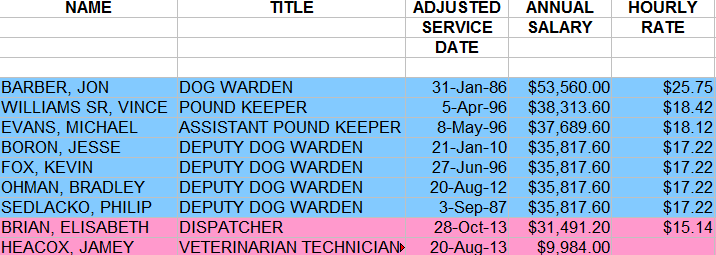
    And that trend appears to continue in today's treatment of the Dog & Kennel, Facilities and Health departments of county government.

    DOG & KENNEL


    As can be seen by the top heavy "blue" table, it it clearly a man's world at Dog & Kennel.

    Jon Barber's predecessor was a female.  However, her two year or so stint seemed to be plagued with a number of difficulties.    It is impossible to know whether or not the problems she experienced,  at least in-part, was a consequence of being a female leader in a man's world. 

    FACILITIES


    After one gets past top seven positions, employment pay/opportunity looks pretty equal. 

    STARK COUNTY HEALTH DEPARTMENT


    With the Stark County Health Department, the pattern continues.

    Top pay/opportunity eschelon of employment go predominantly to men.

    Another noteworthy factor is that only three of eleven board members are female.


    In the originally blog, the SCPR erroneously ascribed the Stark County commissioners has being the appointing authority for board members.  As readers know in reading to this point of the blog, the appointing authority is with various Stark County government entities and the Health Department Advisory Board.

    Nonetheless, The Report urges the director of the Health Department to communicate to the numerous appointing authority the need to have from among them a rough equivalency between male and female board members.