Post "State of the City" message by Canton Mayor William J. Healy, II, local members of the media held a press conference with the mayor which lasts about 26 minutes (see video below).
Among the topics covered include:
the environment factor in Canton pursuing being "the Utica Capital," including on the need for additional state of Ohio regulations on the industry,
numbers of jobs that Utica shale exploration could bring to Canton,
the marketing of Utica,
Healy's contention that Utica benefits all of Stark County,
Other than Utica commercial/industrial prospects for Canton,
Healy's announced Canton drug prescription plan for Canton residents,
the origin of the bump up of $100,000,
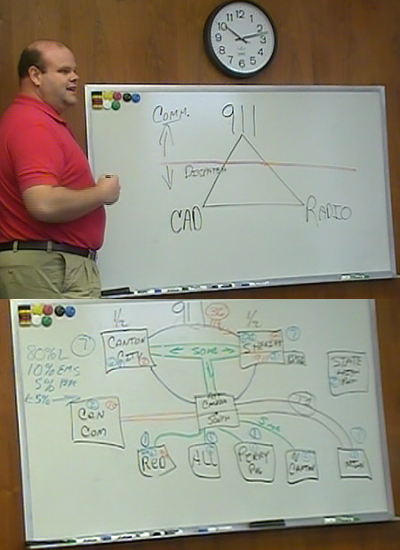
the future of Canton in a countywide 9-1-1 system
the differences between Mayor Healy's State of the City promise to hire up to ten new policemen in the light of his rejection of fire union pressure to hire additional firemen on federal grant money.
The video of Canton Mayor William J. Healy, II answering the questions of local media:
Video of Healy State of City message and text of original blog updated.
ORIGINAL BLOG
One could tell from the get-go of his 5th Annual "State of the City" presentation that Canton Mayor William J. Healy, II could hardly contain his excitement at the prospect of announcing at the very end of his State of the City message that he was dubbing Canton as The Utica Capital as an additional Canton "aka" the Pro Football Hall of Fame city.
Early on in his speech last night in Canton City Council chambers (about 55 minutes in duration) he tipped off the audience, which the SCPR estimates to have been about 75 persons, that he would be having a momentous announcement later on.
In getting to the revelation of the night, the mayor reviewed the last year of his administration in the context of his previously developed and used concept of the four pillars of his effort to revive Canton:
public safety,
education,
neighborhoods-community development, and
economic development
Over the weekend, The Report will be presenting a number of analytical blogs on various aspects of Healy's speech.
The video of Mayor William J. Healy, II - State of the City - March 01, 2012:
On February 7, 2011 the SCPR went to Massillon City Council. In setting up to record council actions for the evening, yours truly struck up a conversation with council Clerk Mary Beth Bailey.
Amid the chit-chat, it came out that years before Bailey had worked for Republican Janet Creighton when she was Stark County auditor (Creighton is now Stark County commissioner).
And that was interesting to learn.
But even more interesting was Bailey's account of how the then Councilwoman Kathy Catazaro-Perry had tried to get her non-renewed for being clerk of council.
The Report thought that was odd and chalked it up to thoroughgoing Democrat Catazaro-Perry playing a little bit of politics in trying to move the Republican tainted Bailey out and an out-and-out Democrat loyalist in.
After all, Catazaro-Perry is closely allied with Massillon Clerk of Courts Johnnie A. Maier, Jr. (also a former Stark Democratic Party chairman), who, in the SCPR's experience, seems to like using available public offices to place consummately loyal Democrats in.
However, Catazaro-Perry failed to convince her fellow councilpersons and her effort failed.
So The Report assumed that the Bailey removal effort was old news and that Catazaro-Perry had moved on.
But perhaps not?
Recently, the now Mayor Kathy Catazaro-Perry submitted her 2012 Massillon budget to council.
Everyone knew it would be an austerity budget and so there was no surprise that she billed her proposed $34.9 million budget as a "two-year financial restoration plan."
Among the major cuts the mayor proposed was 20% for Perry Stergios and his law department.
But that proposed cut paled into insignificance when it came out on Republican Councilwoman Nancy Halter's report that in "the devil is in the details" that Mayor Kathy was proposing to cut Clerk Bailey by 42% (2011 to 2012) from $42,469 to $24,600.
Whew!
What a revelation!
Immediately the SCPR had an aha! moment.
It seems very clear that Catazaro-Perry had not forgotten her council days ill-fated effort to get rid of Bailey and now to the degree she can do so, she appears to be out to make life as uncomfortable for Bailey as she can.
The proposed Bailey cut reeks of Johnnie A. Maier, Jr. Machiavellian-esque politics and what could be a better cover for what appears to be a blatantly political move by Catazaro-Perry than the budgeting process.
With her ever present smile and generally cheerful disposition (in contrast to Maier), one might want to assume that Catazaro-Perry is not nearly as dug in on vengeful personal and partisan politics as Maier appears to be.
But this move is evidence that beneath the veneer, she totally buys into the Maier model that he learned at the feet of former Ohio Speaker of the House Vern Riffe when Johnnie served as his political manservant during the time he represented Stark County's 56th Ohio House District in the 1990s.
If she is adopting Maier's model, then she can expect lots and lots of trouble from the new council. Dominated by Republicans 5 to 4 with a few Cicchinelli Democrats sprinkled, council is likely to take her proposed draconian and disproportional Bailey pay cut as a signal that Catazaro-Perry has opted to play hardball politics with them.
For the sake of and well-being of Massillon and her own credibility as being "different" from other politicians, Mayor Kathy needs to turn away from vengeful politics and the like as her guide.
To the degree the mayor engages in such tactics, she hastens the day that she will be viewed as being like any other well-boiled politician.
At the conclusion of today's regular weekly Wednesday meeting of Stark County commissioners, the SCPR put questions to the commissioners regarding the effect of the petitions calling for the firing of Stark County Dog Pound employee Phil Sedlacko on them.
As laid out in the original blog, the video of The Report's session with commissioners confirms yours truly's projection that the Sedlacko matter is over with in terms of the July 25, 2011 videotaped incident and that no further action will be taken against Sedlacko with regard to that incident.
In the video County Administrator Mike Hanke reviews with SCPR the nature of his visit to the Stark County Dog Pound (Pound) on last Friday (February 24th) and what recommendations came out of his observations of conditions at the Pound.
ORIGINAL BLOG
At about 4:15 p.m. on Monday, Michele Crawford (North Canton), Melanie Medure (Canton) and Mackenzie Smith (Canton) made their way to the second floor of the Stark County Office Building suite of the Stark County commissioners to present hard copy petitions (calling for the firing of Stark County Dog Pound employee Phil Sedlacko) with over 5200 signatures to commissioners.
However, with none of the commissioners present, the trio had to settle for County Administrator Mike Hanke as a person to present the petitions to.
Later on in the day, Ms. Smith took to the lectern at Canton City Council for remarks precedent to her presenting the same set of petitions to Canton City Council President Allen Schulman. The following is a video the presentations.
No matter where one stands on the issue, one has to admire the civic action of Crawford, Medure and Smith as well as the over 5200 who weighed-in on the July 25, 2011 YouTube video which went viral purportedly showing Phil Sedlacko in his capacity as a county employee abusing a dog that he had apprehended.
Also to be commended are the Cantonians/Stark Countians and a few from Summit County who have been attending Canton City Council meetings and making arguments as to their take on Sedlacko video and for a change in Canton's animal control policy.
However, the SCPR believes that neither the commissioners nor the council will heed the plea that Sedlacko be fired nor that Canton will change its animal control policy.
Why not? Isn't the video compelling evidence that Sedlacko belongs nowhere near animals in terms of official public employment? And haven't the petitioners placed the effectiveness of current Canton animal control policy in question?
The Report's read is that the Stark County commissioners believe that the July 25th (2011) incident has already been dealt with by them in a disciplinary way and they are not about to reopen the matter, petitions or not.
As Commissioner Janet Creighton has put it, the county has higher priorities to deal with especially in light of having dealt not only with this matter but with other problems at the Stark County Dog Pound (SCDP - Pound) over the past year or so. Moreover, they are aware that previous boards of commissioners (the last of which included current Commissioner Pete Ferguson) have spent considerable time dealing with the problems of the Pound.
As for Canton City Council, a large factor with them is that many of the councilpersons have constituents who praise Sedlacko and his work and demand that council not move to change a policy which would put the main object in terms of numbers of Sedlacko's work - feral cats - back in their neighborhoods once they have been trapped and neutered and likely inoculated against some diseases (TNR). In addition to trying to persuade council to fire Sedlacko, many if not all of the petitioners advocate that Canton adopt TNR as its new policy.
Councilman Kevin Fisher (5th Ward) likely expresses the sentiment of a majority of council telling yours truly that once Canton gets a handle on its abandoned properties, its highest murder problem in years, its drug problem and its unemployment problem, then, and only then, will he take as a priority working on changing the way feral cats and other wild animals are handled in Canton.
Here is a video sampling of anti-TNR/pro-Sedlacko Cantonians who addressed council Monday night:
A major problem with the petitions as far as Canton City Council is concerned is that they have the signatures of people from all over the world. In relative terms, not many are from Stark County, and, of course, there are still fewer from Canton proper.
There were speakers on the pro-TNR/anti-Sedlocko issues at council on Monday night. Here is a video sampling of that side of the argument.
Perhaps the most persuasive person with Canton City Council at this week's meeting was Canton Health Commissioner James Adams. He presented an argument to council that the risk of disease transmission from wild animals (he put special emphasis on cats) to humans is significant enough that Canton should not, in his opinion, adopt TNR as its policy in dealing with troublesome wildlife.
The Report believes that council - as far as most members are concerned - has not been convinced by the pro-TNR folks that implementing TNR would be a net gain for controlling feral cats within the city and that Adams was a compelling voice to them in that regard.
Here is a video of the main part of his presentation including his specific declaration that he is against TNR for Canton.
So has the petition effort and the city council Public Speaks appearances been "all for naught?"
Hardly.
While they are unlikely to achieve their primary objectives anytime soon, these folks undoubtedly have had an effect on the commissioners, Canton City Council, Mr. Sedlacko, in terms of how he does his job, and those working at and managing the Stark County Dog Pound.
Despite the rocky start that the repair of Stark County's 9-1-1 emergency fire, police and medical services call and dispatch operations got, it appears to the SCPR that the future is looking better for a "state of the art" call receiving and dispatch center to emerge from the ashes of a broken system as reported in 2008.
Stark Countians should pause to reflect upon the contributions of the likes of former Stark County commissioners Todd Bosley (a Democrat), Tom Harmon (a Democrat) and Jane Vignos (a Republican). They proved that Democrats and Republicans can work together for the common Stark County good.
Their key contribution was to forge ahead with imposing a 0.5% sales tax increase in December, 2008, some of which was set aside for the rehab of the dispatch and radio side of a 9-1-1 rebuild.
While the imposition of the tax (which included revenues for the Stark County general fund that likely rankled the public the most) probably resulted in Bosley losing badly to the now former state Representative Todd Snitchler (now Ohio PUCO chair) for Stark's 50th District House seat, it was far from clear that the tax could have passed a vote of the people. Consequently, the SCPR believes that Bosley made a politically costly move in pushing for the imposed tax in support of his endeavor to get 9-1-1 fixed.
Another key player who is still actively involved in the rehab is Stark County Council of Governments (SCOG) Governing Board Chairman (and Jackson Township fiscal officer) Randy Gonzalez.
Gonzalez has been the personification of commitment to the rebuild of Stark's 9-1-1. He has been intent on seeing it brought up to date, going back some 20 years or so. But in persisting, he has had to deal with repeated frustrations.
First and foremost was finding a funding mechanism to do the fix with. Bosley's tax initiative somewhat solved that issue. Somewhat? Yes, in the sense that the tax was repealed by a massive citizen negative reaction to the tax being imposed on. It was repealed by about a 2/3rds majority in November, 2009.
Another frustration for Gonzalez has been, and continues to be, Nimishillen Township's refusal, under the stubborn leadership of its Fire Chief Rich Peterson (seemingly holding the Nimishillen Township trustees in thrall - no matter their particular identity), to Nimishillen's CenCom dispatch center being brought into a merged countywide dispatch operation. Many Stark County fire, police and emergency medical officials believe that countywide centralization would result in more a efficient and error free dispatch operation which, in some instances, will save lives.
Still another Gonzalez frustration was the emergence last year of Canton Mayor Healy's (and his safety director Tom Ream [who, by the way, chairs SCOG] - of course, no one in the Healy administration dare disagree with the mayor) opposition to merged dispatch including Canton UNLESS it was controlled by Canton.
In staying the course, Gonzalez deserves laudatory recognition for being the foremost Stark County official in persisting in moving Stark's 9-1-1 into consolidated status.
Other front and center prime movers for fixing emergency call receiving and dispatch are Stark Emergency Management Agency Director Tim Warstler 9-1-1 (dispatch side) and Project Manager Joe Concatto.
Times have been tough for finishing out the rehab of Stark's 9-1-1 system. A severe recession of the American economy beginning towards the end of the Bush administration in 2008 and on into the Obama administration has likely been the culprit.
Public funding (in the form of grants) have pretty much come to a grinding halt (except, perhaps, for the radio part of the rework) which brings The Report to the reason why yours truly is taking a new look at the pace of the SCOG effort.
Last Tuesday (February 21st), the Board of Stark County Commissioners had Director Warstler and Deputy Director Rich Weber in for a work session on the progress being made by the call receiving side of 9-1-1. They articulated to commissioners their goal to create a sustainable model of ongoing renewal of the capital equipment (computers, phones, software upgrades and the like) which, they say, needs to be done every 5 to 7 years.
While there are personnel costs, the major concern is generating the monies necessary to fund the several million needed to update capital equipment. Planning is done in the first two years of the 5 to 7 year cycle whereas the actual updating mostly takes place over the remaining 3 to 5 years of the cycle, so says Director Warstler.
The short of the presentation made last Tuesday is that there are two possible barriers to Warstler and Weber being able to create that sustainable model. They are:
that the Stark County 1/10th of a mill countywide levy which provides over $500,000 ($537,712 last year) a year in annual revenues expires on December 31, 2012, and
that the state of Ohio wireless fund monthly assessment of 28 cents on each and every Ohio telephone bill also expires on December 31, 2012 which provided Stark County with $1,023,234 last year.
Here is a copy of Stark EMA's 2011 revenue/expense budget (remember, this is ONLY for the call receiving part of 9-1-1):
One thing for readers of this SCPR blog is to focus on is the CAPITAL OUTLAY item in the budget. This line item specifically represents monies spent in any one year over the non-planning phase of the cycle replacing worn out equipment/software, et cetera.
For Stark County taxing purposes, the question before the Stark County commissioners between now and some time in August of this year (the filing deadline for placing issues on the Stark County ballot), is:
whether or not to place a renewal or a replacement (which takes advantage of in increase in the total county real property valuation) on the ballot,
for what millage (currently 1/10th of a mill), and
for a period of years or continuing indefinitely.
Moreover, Warstler will have to stay closely tuned to what the Public Utilities Commission of Ohio (PUCO - currently chaired by former Stark County state Representative Todd Snitchler [R - Lake]) does in terms of increasing/reducing/maintaining the 28 cents per month, per Ohio telephone bill wireless assessment currently in place.
The SCPR's read is that it likely will remain at the 28 cents for a limited period of time based on recommendations contained in A Report by the Interim 9-1-1 Coordinator (PUCO).
The future for 9-1-1 in Stark County?
It depends.
If Stark Countians see the wisdom of advancing incrementally towards a state of the art system by renewing or replacing the expiring levy (which in The Report's understanding might be bumped up through a combination of replacement, and/or millage enhancement) to raise another $250,000 per year to about $750,00 and the state of Ohio maintains the 28 cent a monthly telephone bill assessment, then the future is bright for not only sustaining the system but for bringing it to and keeping it at the cutting edge.
If the local levy fails or Ohio reduces its assessment significantly, then Stark County likely will go right back to where it was - in relative terms - when the GenCom report was done in 2008.
Warstler and Weber spent one and one half hours presenting to commissioners on the 21st. Afterwards the SCPR sat down with them and what follows in a video compilation of what they had to say in amplification of their presentation to the commissioners.
9-1-1 DISPATCHING (INCLUDING RADIO)
At the conclusion of the meeting at which Warstler and Weber made their presentation, yours truly asked County Administrator Mike Hanke for an exact number on what remains in the Stark County general fund earmarked specifically for 9-1-1 dispatch and radio.
The answer: $2,551,107.14.
A follow-up question obviously is: how and when is it to be spent.
For an answer to that question the SCPR turned to Joe Concatto (a former Canton fire chief and city of Canton Creighton administration official) who is 9-1-1 Project Manager (dispatch/radio side).
In an email, here is what he had to say:
Martin,
Part of the 2.5 million is planned for a countywide Computer Aided Dispatch (CAD) system. The Request for Proposal and the Specification for this system is complete and we are waiting for approval from the Commissioners to go out to bid. The systen (sic) is estimated to cost between 1.2 to 1.5 million dollars. This system could be shared by existing dispatch centers in the same manner as the Next Generation 9-1-1 System.
Although this does not create a Countywide 9-1-1 Dispatch Center as we had planned, it is a start. I still believe that consoldating (sic) all the dispatch centers in the county into one center is the best approach for our County.
One major issue with sharing the CAD system is also sharing the cost for the annual maintenance and updates for this system. These costs would have to be shared by the dispatch centers who wish to be a part of the project. These cost could be about 12% of the cost of the sytem (sic) paid each year. Another question is who would own the sytem. (sic)
The County Commissioners are still reviewing whether it is legal to give the 2.5 million dollars to SCOG. [Stark County Council of Governments]
Radios for emergency safety personnel in the County is still an issue. I do believe that we need one radio system in this county the same as we need one dispatch center. However creating one dispatch center and one radio system take two different approches (sic) and one should not be contingent on the other. With that said part of the budget created by SCOG for the 2.5 million dollars includes approximately $700,000.00 for safety forces in the county to purchase 800 MHz radios. This would be in the form of "grants" and would only represent a portion of the cost for these radios.
From Concatto's description of the current status of the 9-1-1 project, it appears to the SCPR that Stark Countians who live in jurisdictions which have not fully embraced (most notably Canton and Nimishillen Township) the notion of a true countywide 9-1-1 call receiving and dispatch should, for their own maximum safety and for that of those who travel to or through their communities, press their political leaders to get on board the work of Warstler, Concatto, Gonzalez, the Stark County commissioners, SCOG and others.
The Report views the recalcitrant public officials and their "accountable to the public political leaders" as being irresponsible in their obligation to look out for the well-being of all Stark Countians!
On matters of emergency services, no community in Stark County is an island unto itself.
Commissioners appeared at last week's meeting to acknowledge that work needs to be done to solve long standing problems that have plagued the Pound.
In fact they sent Chief Administrator Mike Hanke out to the Pound Friday to look into Pound operations. Hanke is to consult with commissioners today in one-on-ones as to his findings.
But the consultation and further commissioner response appears to be "too little, to late" as far as a group of Facebook activists (Petitioners) are concerned.
It seems that rather than quieting public outrage, the response of commissioners has been viewed to be inadequate by the Petitioners.
Canton officials have a similar problem to Stark County in dealing with the Incident in view of the city's recently extended 90 days contract with Sedlacko. He is believed to be opposed to a proposed change by some that Canton adopt a trap-neuter-return (TNR) in place of the existing Canton policy of animal control.
Canton is using the 90 days to determine whether or not an animal control policy change is in order and whether or not to continue with Sedlacko as its animal control officer. Council is having Canton Health Commissioner James M. Adams appear before them at 6:15 p.m. tonight on the animal control issue.
Examples of questions being raised by the commissioners initial response include:
"If they knew he was coming, won't SCDP employees be minding their "p's and q's" to the utmost?" So why did commissioners announce the date and the time of the visit? Wasn't the Hanke visit nothing more that a "dog and pony show?"
Good questions, no?
In addition, the SCPR has received an e-mail recounting the reaction of a person on viewing/hearing the responses of Stark County Prosecutor Michael Bickis and the commissioners at the Februrary 22nd post-meeting press conference which was filmed and published with last Thursday's SCPR blog.
Here is that person's statement:
I just finished looking at the Commissioners press conference regarding Phil and the dog incident.
Once again they are trying to sweep it under the rug for their teamster buddies.
When I heard the report from the city prosecutors office I couldn't believe what I was hearing and I'm so angry right now. The prosecutor said there wasn't probable cause of criminal activity. Maybe someone should ask them how long it takes for Telazol, the tranquilizer he used, to wear off, being an Euthanasia Tech I know the duration is at best 30 Min, and maybe ask a vet how long it would take a dog to pass away after an artery has been "nicked".I'm sure it wasn't some 10 hours later. A dog who was tranquilized with a dart is not going to bleed like that, if at all.
Another thing that was brought up that was in the so called report was that Reagan [Stark County Dog Warden Reagan Tetreault] applied pressure to the wound and stopped the bleeding. From what I see in the video, she touched the dog for all of about 10 sec, she must have magical hands to stop arterial bleeding that quick and the dog to be still alive when they brought it to the vet 10 hours later.
I think someone should get a copy of this report and investigate it.
To me, it's a doctored report to save their butts.
There are more things that I could pick apart.
If you want to share this with others that want to look into this more, I certainly have no problem with it. I think the news should know and investigate and ask questions as well.
The SCPR is also told that Stark County Dog Warden Reagan Tetreault returned to the Pound after last Wednesday's commissioner meeting only to be heard to say that Ms. Shankle had made a fool of herself in her presentation to commissioners on Wednesday in asking them to do a complete rework of Pound operations, including another change in warden which last occurred in January, 2010 when Evert Gibson was fired by a former board of commissioners.
Still another citizen makes the following observations (not the entire statement):
We [Daisy Dog Rescue] had an uphill battle in those days with Jane Vignos, Gayle Jackson, and Richard Regula who stated "having a country club for dogs was more than the county could afford".
Phil Sedlacko is one of many deputies at that pound that needed to be weeded out many many years ago. So many dogs have suffered at the hands of each of them it makes me physically sick to my stomach. It was emotionally draining to see what we saw, and step in there day after day to take the pictures & receive the harassment we did because we were Whistle Blowers.
Commissioner Bernabei on Wednesday appeared to commit the commissioners to hold a work session to give the complaints of Pound operations a full public airing.
In view of the continuing questions, it seems to the SCPR that such a work session is a very good idea.
But a work session in and of itself will not be enough.
The commissioners will have to convince (not unlike the job they did in convincing Stark Countians of the authenticity of Stark's financial crisis in persuading public support of the 0.5% sales tax ballot initiative) those who hold the treatment of impounded dogs near and dear to their hearts that the commissioners:
take the complaints seriously and will investigate them fully,
address to the public specifically what in their view needs fixing, and
lay out a plan of action with a timetable to which they can be held accountable to achieve the objectives of the plan.
As for Canton City Council, it appears that in order to satisfy the Petitioners, they will have to move their "determine the ultimate fate of Sedlacko's contract" timetable up.
The larger issue for both the commissioner and the councilpersons is whether they are going to stand their ground on their agenda and timetable or are they going to knuckle under to the Petitioners.
Such typically is the dilemma that government officials, elected or unelected, face when governance goes awry.
Over time, these decision set the tone as to whether or not the general public believes that government is responsive.
So commissioner and council handling of this matter has more at stake that the fate of Phil Sedlacko.
Here is a copy of a document issued by the Stark County commissioners last Wednesday that purports a be a fact finding of what actually occurred in the dog darting incident:
That is the lure of the Robert Cyperski campaign to attract prospective petition signers to his event tomorrow (Sunday) from 1:00 to 5:00 p.m. at the Belden Village Holiday Inn located at 4520 Everhard Road, NW in Canton.
Cyperski has decided to attempt collecting 5,002 signatures by the filing deadline of March 5th to get on the ballot as an "independent" candidate against incumbent judge and Republican John Wise.
Wise has been a 5th Court of Appeals (5th COA) judge since 1995 and is now at the point that he wants to retire as judge at a retirement annual income of about $116,160 and then stand for re-election to the very same job and collect an additional $132,000 and thereby top out at about $248,160 or nearly "a quarter of a million dollars." Hmm? Not bad!
Will Cyperski takes offense at those numbers together with the reality that Wise, in running again, is freezing out the opportunity of younger aspirants to serve on Ohio's second highest court (second only to the Ohio Supreme Court).
Both Cyperski and Wise are well-qualified. So, if he gets on the ballot, the issue will not be whether or not Wise has been an able judge or as to his qualifications. It will be an opportunity for Stark Countians as well as the citizens of 14th other counties which comprise the 5th COA to vote on the issue of "double-dipping."
Cyperski's campaign, if he can get the mind boggling 5,002 signatures, will have an evangelistic fervor to it. That's how passionately he is driven on making his mark against the infectious growth among public officials (mostly unelected ones) to double-dip.
As a sidenote here, the Stark County Political Report points out that candidates for either the Republican or Democratic nomination for this office is 50 signatures. Yes, 50 signatures as compared to over 5,000 for an "independent" candidate.
It just goes to show how Republican and Democratic politicians conspire with one another to keep the political competition out.
The Ohio General Assembly (OGA) has changed Ohio's policies over the last 10 years or so to allow the retire/rehire phenomenon to flourish.
Judge Wise and the unelecteds are doing nothing wrong from a legal standpoint in advantaging themselves of retire/rehire.
But nonetheless the practice is not setting well with much of Ohio's voting public.
Trouble is for Ohio's voters is that they have to be frustrated that they have been provided with no medium with which to weigh in on the issue.
One has to wonder why the OGA has shut them out of the process of determining what the policy of retire/hire or double-dipping or whatever one wants to call it ought to be.
A Cyperski/Wise match up on the issue provides Stark Countians with a unique opportunity to be heard on retire/rehire.
Legislation has been introduced in the current session of the General Assembly to stymie the retire/rehire growth, to wit: House Bills 202 & 388.
But the SCPR takes these measures as being a sop to the voting public because of the increasingly vocal outcry.
Unless and until something like a sitting judge gets defeated on the unmistakable fact that voters have said no on the basis of retire/rehire, The Report does not believe that most representatives and state senators are interested in seriously addressing the issue.
For the sake of discussion, here is a look at the two bills sitting in the legislative hopper of the Ohio General Assembly.
HOUSE BILL 202
House Bill 202 is opposed, of course, by the Ohio Judicial Conference. Here is an extract from its website of the conference.
HOUSE BILL 388
The main problem with this bill is that it does not to affect elected officials which, of course, means the members of the Ohio General Assembly itself (which has upwards of a dozen members who fit the retire/rehire category), judges and obviously any other Ohio-based elected official such as Stark County Sheriff Tim Swanson, who, if the SCPR understands correctly prior statements he has made, has three retirement accounts.
Nevertheless here are some excerpts of descriptive material (by WNWO Newsdesk) as well as a number of quotes by the chief sponsor of HB 388 (Republican Rex Damschroder, the 81st House District) as to the bill's "other" impact:
HB
388 will suspend, during the time of employment, the retirement
benefits of a public retirement system retiree who returns to public
employment. Under the bill, all government workers, including elected
officials, will be prohibited from a practice often known as
"retire/rehire"– where workers are permitted to receive their pension
benefits while continuing to work in a public sector position.
NOTE: Although the WNWO description says "including elected officials," a SCPR check of the actual language of the proposed legislation which clearly excepts out "elected" officials.
Damschroder quotes:
"The
goal of HB 388 is to bring common-sense economic reforms to our public
retirement systems."
"We have all witnessed or
read about examples of double dipping in our local area and the public
outrage that always follows."
"For
every instance of retire/rehire, one less job is available for new
public workers. Changing the current system is
essential in order to save the integrity of Ohio’s five public
retirement systems. Asking the taxpayers of our state to support double
dipping in today’s economy is unrealistic.”
As written above, the SCPR believes that HB 202 and HB 388 are not serious efforts to deal with increasing public criticism of Ohio's retire/rehire phenomenon.
Accordingly, The Report endorses Cyperski's attempt to get on the ballot and encourages all Stark Countians to help Cyperski get on the ballot so that the issue of double-dipping can be addressed at the ballot box.
While some will still vote on Cyperski or Wise on factors other than retire/retire/double-dipping, the campaign that Cyperski will be running and which Judge Wise will be forced to defend is whether or not retire/rehire is a good idea.
Once the people have had an opportunity to have their say the legislature will have a true indicator of whether or not they need to re-legislate on the matter in order to truly reflect the people's desire on the practice.
B.A. - Political Science
J.D.
AN INDEPENDENT MINDED POLITICAL COMMENTATOR
Until 1976 I was a Republican. Since then I have considered myself a Democrat. So after long term stints of being a Republican, then a Democrat, I have come to the political position I feel most comfortable with - being an INDEPENDENT MINDED ANALYST who demands effectiveness of our politicians - Republican, Democrat or whatever.
I have changed my political affiliation to "non-partisan" by not voting in either political party primary election.