Showing posts with label Stark EMA Director Tim Warstler. Show all posts

Monday, June 15, 2015

PART 2 OF SCPR MULTI-PART SERIES: IN PARTS OF U.S. ONLY 10% SUCCESS RATE IN LOCATING 9.1.1 CELLPHONE CALLERS!

HOW DOES STARK COUNTY STACK UP?

Going back to May, 2008, The Stark County Political Report has been Stark County's most reliable and prolific source of information on the condition of Stark's 9-1-1 call receiving and dispatch system.

Back in those days, a special commission put together by various interested parties to audit Stark's system came back with a voluminous report saying that Stark's emergency services communication network was broken.
(chiefly, former Stark County commissioner Todd Bosley, a Democrat) jumped on the report as a reason why Stark Countians should accept having a 1/2 cent sales tax imposed on us.

Fellow Democrat (and, this year a candidate for Canton city councilman-at-large) Tom Harmon and Republican Jane Vignos joined in.

But fixing the broken emergency services was only part of the reason for the tax.

A less publicized reason (if referred to at all) was the county's desperate needed for general fund monies.

As politicians are wont to do, the fear factor that you and I would not receive life-saving fire, ambulance or perhaps (but to a much lesser degree) police services was invoked as justification for "imposing" the sales tax in December, 2008.

Millions were collected for the general fund deficiency and for fixing the broken 9-1-1 system before voters stepped-in on the initiative of civic activists in the November, 2009 election to rescind the tax.

Only with the election of Republican Janet Creighton and then-Democrat Thomas Bernabei as Stark County commissioners in November, 2010, did Stark County did Stark County have leadership in place which had the ability to set the politics aside to ensure that what money the December, 2008 imposed tax generated for a 9-1-1 fix would be accomplished in a non-political way.

To fully appreciate a more detailed accounting for the political maneuvering that came into play with spending the influx of taxpayer money to be applied fixing the broken 9-1-1, readers ought to read Part 1 of this series which began on June 1, 2015.

Although the SCPR questions whether or not the current set of commissioners got the most bang for the buck in purchasing a new Computer Assisted Dispatch (CAD) system last year, the Creighton and Bernabei led board seems to have take much of the politics out of how the process of fixing 9-1-1.

Earlier this year The Stark County Political Report happened upon an article published in USA Today that focused on a problem across American in which calls for emergency assistance from cellphones did not provide location data and therefore hampered if not obliterated the ability of local emergency responders to make timely (i.e. in time to save a life) responses to the frantic calls of mobile callers.

Readers of this blog:
  • in order to grasp the significance of "location data," and 
    • to get a full appreciation of the critical importance of same to each and everyone of us in terms of being located
    • in order to receive emergency medical care in the event of a:
      • heart attack,
      • stroke,
      • automobile accident injury,
        • and the like
absolutely need to read the USA Today article cited above.

Here is a LINK to that USA Today baseline article.

Please take about five (5) minutes or so to read this article so that you can appreciate fully the answers to SCPR "on camera" questions by Director Warstler and his highly able staff.

Your life could depend on your doing so!

In Part 1 of this series, the SCPR began unfolding segments of a one hour or so vide eo interview with Stark's Emergency Management director Tim Warstler on the primary question of how Stark County stacks up with the rest of America in county's ability to know the locale of cellphone callers for ambulance, fire and police services.

Parts of the nation only have a 10% success rate providing the critically need location data to emergency call receivers.

In Part 1, we got to know Emergency Services Agency director Tim Wartstler.


Today, in Part 2, we get more into the nitty-gritty of the status of Stark call receiving capability in terms of EMA personnel obtaining pin point location information from cellphone callers.


In the foregoing video segment, Director Warstler reveals for Stark County that:

  • the emergency calls which are the most troublesome in terms of 9-1-1 knowing where the caller is located are VOIP (Voice Over Internet Protocol) call ins.
    • Note:  VOIP calls account for about 7% of all 9-1-1 calls and it appears that one calling via VOIP has he greatest chance of emergency responders not being able to find him/her.
  • the most reliable calls, in terms of where the caller is located, of course, are landline calls, which, unfortunately only account for 13% (so far this year) received by Stark's 9-1-1's emergency call receiving unit,
  • percentage wise, cellphone calls (which account for 80% of all emergency calls in Stark County) provide good caller location data 66% of the time.  So 34 callers out of 100 Stark County cellphone callers run the risk - so far this year - that emergency responders will not be able to locate the emergency situs in a timely fashion,
Warstler was unable to say whether the problem is with EMA utilized software or lies with AT&T.

The foregoing data is the best that Warstler and is team of emergency call receivers can provide at this time.

Ohio is working on improving data collection so that Ohioans/Stark Countians can know more precisely the reliability of technology in place within the county and state in terms of providing accurate and precise location data.

In upcoming Part 3 in coming days, Director Warstler and the SCPR discuss a Stark County location incident problem and also the likelihood that Stark County could experience a problem like that which occurred in the Atlanta, Georgia area.

Tuesday, November 26, 2013

(VIDEOS) A STARK COUNTY GOV'T "DEMOCRACY IN ACTION" WORK SESSION GETS ANSWERS & GENERATES SOLUTIONS FOR 9-1-1 CALL RECEIVING FAILURE?


STARK COUNTIANS CAN NOW REST EASIER THAT THERE WILL NOT BE A REPEAT FAILURE?

UPDATED:  11:45 AM

VIDEOS

STARK CO. COMMISSIONERS
CONDUCT INQUIRY
ON
WHO WAS RESPONSIBLE
FOR
10/13/2013 
9-1-1 CALL-IN GLITCH

PRIMARY PARTICIPANTS
  • Commissioner Tom Bernabei
  • Commissioner Janet Creighton
  • Paul Stoffels of AT&T
  • Andy Kopystynsky of AT&T
  • Jeroen Witte of Cassidian
  • Director Tim Warstler of Stark EMA
  • Joe Concatto, Project Mgr. Stark 9-1-1
  • Tracy Houge, Jackson Twp Fire Chief
  • John Bacon, North Canton Fire Chief
  • Bruce McAllister, SC Sheriff Dir of Info Svcs
 =========================================
TIM WARSTLER
STARK EMA DIRECTOR
ON
THE
OCTOBER 6TH
GLITCH 
======================================== 

If a Stark Countian had a emergency between the approximate hours of 9:30 through Noon on Sunday, October 6th, there was a very high probability that any 9-1-1 emergency calls to the Canton Communications Center and the Stark County Sheriff Department Call Center were going to go "unanswered!"

Of course, most of us were unaffected.

But if you were one of the affected, it could have been "a matter of life and death."

Plaudits go, quite naturally, to those folks in the loop of emergency call receiving for Stark County who identified the shutdown and took remedial measures as soon as they possibly could.

A Stark County Political Report "Hats Off" to those Stark County based fire, police and administrative officials who acted quickly.

Once an incident ("problems do happen") like the one of the 6th occur, it is important to find out:
  • why it happened?
  • who is responsible?
  • what is the remedy for making sure it never happens again? and
  • who has the responsibility to implement the fix?
One way answers to these questions generally come is because someone in the day-in, day-out media digs, digs and digs some more in a fevered quest to ferret out the why, who, what and who questions set forth above.

Another way is for government to conduct an open to the public thoroughgoing inquiry meeting.

Before the election of Democrat Thomas Bernabei and Republican Janet Creighton to the Stark County Board of Commissioners, it was likely that no such meeting would have ever crossed the minds of the collective former boards of commissioners who have served the Stark County public.

With their election in November, 2010 and being in office as a tandem as of January 1, 2011, the two then-neophyte commissioners declared that the board was not meeting nearly enough and to boot needed to institute work sessions in which they could do far ranging scrutiny of anything connected in any way to Stark County government operations.

Since the meeting began in 2011, the commissioners have used the work sessions to delve deeply into Stark County government and take much needed corrective action for problems identified as being such, or, alternatively, to press those county officials who are charge of the problematic item(s) to apply a fix.

With the October 6th incident and Stark County government's prime role in providing for the safety and general welfare of Stark Countians, the commissioners called a work session meeting for November 18, 2013 in which all the "prime-players" in the 9-1-1 call receiving outage were called to account.

And that included players from the private sector (mainly AT&T) who contract with various aspects of county government to provide essential emergency communications services.

The Stark County Political Report was at the work session and recorded almost all (missed the first few minutes because The Report was interviewing a previous work session participant) of the commissioners' generated inquiry.


The key player in the provision of emergency services to Stark Countians is Tim Warstler who has the official title of being the director of the Stark County Emergency Management Agency.

Here is a video of a SCPR interview with him following up on some of the points made by participants as seen in the video above.


All-in-all, the Stark County Political Report believes that Stark Countians should be highly impressed and pleased that the Stark County commissioners did dig deep in their November 18th work session into the October 6th failure in their quest to get answers and provoke fixes so that none of us will ever experience needing emergency help - which could be a "life or death" matter - only to find that "the 9-1-1 call receiving/dispatch system" is down.

Many of us complain when government fails.  But do not give "credit where credit is due" when government works.

The November 18th meeting is a concrete example of government succeeding in fixing accountability where it lies and to do so in a transparent, effective (results producing) way.

Kudos! to the Stark County commissioners!!!


    Friday, June 28, 2013

    FROM A POLITICAL PARTY WHICH STANDS FOR "LESS GOV'T;" WE GET MORE "UNNECESSARY" GOV'T? STARK TO GET A "DWART."


    Everybody knows that the Republican Party has lopsided control of the Ohio General Assembly (OGA) these days.

    And one of the "prime" mantras of the GOP from the national level to the local level is what?

    You've got it!

    Less government is better government.

    Back in October, 2011 a Zanesville area resident released a slew of wild and exotic animals from his property which resulted in law enforcement having to slay some four dozen of them in order to protect the public.

    While it was a tense situation, the fact of the matter is that  state of Ohio officials and local law enforcement were up to handling the bizarre actions of the Zanesville wild and exotic animal owner.

    The outcome is lamentable.

    But, again, it got handled and it is hard to see how another layer of government would have altered the outcome more in tune with the sensitivities of animal lovers.

    In signing the bill (Senate Bill 310, sponsored by Zanesville Republican Senator Troy Balderson), Republican Governor John Kasich said he didn't think such an incident would ever occur again.

    Implicitly, Kasich acknowledged at the signing that the Legislature got bullied by a "'small but loud and emotional' animal owners group."

    How unRepublican?

    But the SCPR does have to hand out kudos to Stark Countian and state Representative Christina Hagan (R-Marlboro; hardly a favorite of The Report) for being loyal to her political beliefs in not unnecessarily expanding government in voting "no" on SB 310.


    Predictably, Stark County Democrat Stephen Slesnick (Canton - 49th House District) voted for the bill.  Democratic officeholders, by and large, love to expand government.

    Interestingly enough so did (who knows what his political philosophy is, if he has one) Republican Kirk Schuring (Jackson - 48th House District) and a bunch of other supposedly "less government" Republicans.

    In the Ohio Senate, Scott Oelslager (R - Plain Township - the 29th Senate District) followed Schuring's lead.


    Note that in the Senate, there was only one Republican true believer in smaller government is better government.

    Democrats do not have enough votes to pass (or even get out of committee) bills on anything in the OGA.

    But they were probably "ga-ga" over the opportunity in April, 2012 to join with Republicans in a "perfect political storm" setting to add another layer of state and local government (and its expense of implementation and continuing operation) on Ohioans.

    Just look at all the things that SB 310 does (LINK).

    And take a look at the work of the Ohio Department of Agriculture in getting the bill implemented and grafted into the permanent bureaucratic scheme of Ohio and local government (LINK).

    A clear cut example of the expansion of unnecessary state government at the hands a Republican supermajority, no?

    On Wednesday Director Tim Warstler of the Stark County Emergency Management in responding to the bureaucratic overlay put in place by SB 310 under the Ohio Department of Agriculture.

    He appeared before Stark County commissioners in his bureaucracy imposed job to get a Dangerous Wild Animal Response Team (DWART) initiated.

    Warstler needed a commissioners' resolution authorizing same for Stark County and he got it.

    In his presentation, Warstler did muse on whether or not SB 310 was an overreaction on the part of the legislature.

    In a one-on-one interview with the SCPR after his session with the commissioners,  Warstler gave the most persuasive case for the OGA having passed SB 310 and Stark County having a DWART.

    He said that perhaps an unarticulated reason for the law was the fear that terrorists would latch onto the idea that they could create mayhem among the population by releasing secured wild and exotic animals from the controlled environment.

    Nearly every county of Ohio has some facility or citizens who harbor wild and exotic animals.

    A prime example for Stark County is the Stump Hill Farm (LINK) which is located on Klick Road.


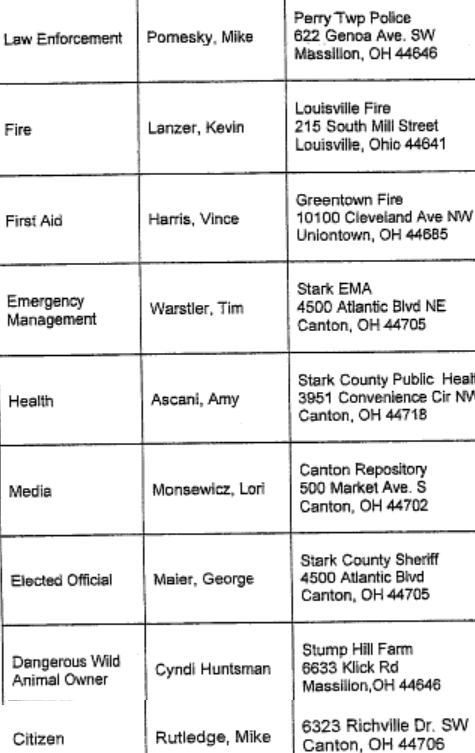
    And here is a list of Stark Countians who are being considered for membership on the Stark County DWART.


    In the end, the SCPR thinks that the next time a Stark citizen hears a Republican candidate/office holder opine about "less government is better government," the citizen should say "Oh, yes!  Tell me about the Republican initiated and passed Chapter 935 of the Ohio Revised Code.

    Is ORC Chapter 935 legislation an example of "less government is better government?"