On Monday evening there was a campaign finance event at the posh Brookside Country Club located in Stark County's richest community; namely, Jackson Township. (LINK to prior SCPR blog)
A top contribution of $25,000 per person was being asked for which got a contributor participation in a private dinner with the star of the event.
Featured at Brookside was embattled Republican presidential nominee Donald J. Trump.
Through June 30th, he had only raised $4,128 from Stark County based contributors.
Originally, on or about June 15, 2015 or shortly thereafter, Trump said he was going to finance his own campaign so that he would be beholden to no one.
And he has put a lot of his own moola into the campaign.
Like so many of his positions, Trump has changed positions on the financing of his campaign and is out hot and heavy these days raising money to finance his knock down, drag out battle with Democrat Hillary Clinton.
In about a month, we will know who attended the Brookside event and how much they contributed to either Trum or the Republican National Committee.
The Federal Election Commission does a much better job than the state of Ohio in making available to voters relatively close to "as contributions occur" information (ranging from 15 to 45 days in lag) as to whom is supporting various candidates for public office.
In Ohio because our state legislators do not apparently think it is an important fact for voters to know expeditiously, we only get that information a couple or so weeks before any given election.
Undoubtedly, Stark County's voters want to know who in Stark over the past year or so have been supporting the candidates for president listed above.
The SCPR has compiled such a list from data supplied on the FEC website.
The rankings of contributions per candidate from FEC listed Stark Countian contributions (by zipcode):
And here is Stark's top 100 list as of June 30, 2016 including former Stark County Court of Common Pleas Court judge Charles Brown ($2,700 Kasich, Brown is a former Stark GOP chairman and Canton City Council president Allen Schulman ($1,000 Clinton):
On April 26th, (LINK) The Stark County Political Report provided Stark County taxpayers with a copy of data put out in report form by the Stark County commissioners on the "current" financial health of our county.
In November, 2010 Stark Countians made a wise choice in electing Democrat Thomas Bernabei (now "independent" mayor of Canton) and Republican Janet Creighton to commissioner positions.
The county was in the midst of a public confidence crisis as a consequence of upwards of $3 million having been stolen by then former chief deputy treasurer Vince Frustaci. Frustaci pled guilty to federal charges and is currently serving a 10 year sentence in federal prison.
The SCPR credits Bernabei and Creighton with shaving right the Ship of State/Stark County to the point that county taxpayers were willing in November, 2011 to pass a 1/2 cent sales tax increase by a comfortable margin.
That sales tax will come up for renewal in 2019.
As part of the commissioners' continuing commitment to instilling public confidence in how they and other county officials (many of whom are elected independent of direct control by the commissioners) spend your tax dollars, they had the wisdom to hire one Chris Nichols (also a Canton Township trustee) to be the county's budget director.
Nichols has done superlative job of gathering and publishing county revenue and expenditure data for the edification of county officeholders, employees and most importantly in a highly understandable format Stark County taxpayers.
All Stark Countians have an obligation in our role as responsible citizens to understand government finances.
Here is a video (i.e. 60 slides which takes about 10 minutes to view) of Nichols' March, 2016 budget presentation that ALL Stark Countians should take the time to view.
The presentation last seven minutes if not paused.
Yours truly encourages to hit the pause button for those slides that catch a viewer's eye.
Here is the slide presentation.
And here is a seven slide presentation on the 1st 2016 Quarterly Report.
And finally, here is the seven slide presentation for the current (2nd 2016 Quarterly Report).
Now to the expected as of July 1, 2017 nearly $2 million annual loss in revenue to the county treasurer.
Let's have Nichols explain it by sharing the following Nichols e-mail to the SCPR, to wit:
Chris B. Nichols <cbnichols@starkcountyohio.gov> Today [Tuesday, August 9] at 11:10 AM To: Martin Olson Good morning, Martin. Starting July 1, 2017, due to a Federal Mandate, a Sales Tax Exemption will apply to Medicaid MCO’s (Managed Care Organizations). I have attached an information document provided by the CCAO (County Commissioners Association of Ohio) and also a document prepared by the Ohio Department of Taxation, which calculates the expected impact on County and Transit Authority Sales Taxes. In short, Ohio counties can expect to lose about $148,000,000 in annual Sales Tax Revenues.
Regional Transit Authorities (including SARTA), which have Sales Taxes can expect to lose $33,576,000 in annual revenues. In Stark County, we should expect to lose $1,875,577 in annual Justice System Sales Tax (JSST) Revenue. This represents a 6.5% reduction in JSST revenue, per year. When looking at our combined General Fund and JSST appropriations, it represents a 3% reduction in our total annual revenues, which are available for appropriation. (emphasis added by SCPR) SARTA will lose the same 6.5%, but since their Sales Tax is only 0.25%, their dollar impact is expected to be $937,788 annually. I’m not sure what % of their total revenue that represents. Stark County also has the potential to feel a couple of other impacts from this change. The State of Ohio’s Sales Tax revenues will be impacted by about $550,000,000 per year, due to this change. That revenue reduction to the State could impact us in the following ways: 1. State Sales Taxes are part of Ohio’s General Revenue Fund, which is what the Local Government Fund formula is applied against. A reduction in State Revenues will also mean a reduction in Local Government Fund revenue to Stark County and other political subdivisions. I would expect this impact to be much less than the direct impact of the Sales Tax. 2. With that big of a reduction in State Revenue for the next two-year budget cycle (about $1.1B), further cuts in the Local Government Fund could be put on the table, to help backfill that revenue loss to the State. This will bear watching during the next State Budget Cycle, in addition to active communication with our local Legislators to protect Ohio’s political subdivisions from further cuts to the Local Government Fund. As you will read, the CCAO is making it a Legislative Priority for the State to find a solution to replace this revenue. But, as of now, we have to work on the assumption that the revenue lose will happen with no replacement. We are fortunate that the County is currently in a solid financial position, so we are in a place to work through this revenue loss, but it will certainly impact our budget and operations in the coming years.
These types of “surprises” are why in my budgeting and forecasts, I try to maintain conservative assumptions in both revenue and expenses. This significant revenue cut also shows why it is prudent for the County to maintain a reasonable carry-over balance, so that when things like this happen, we do not need to make sudden or drastic changes, but can work through them strategically and methodically. If you have any questions or need anything else, please let me know. Chris
There you have it folks, the latest on Stark County finances.
Stark Countians should be enormously impressed with the accountability that the commissioners have directed Nichols to provide to each and every one of us.
If Donald Trump is to win Stark County in the 2016 presidential election general election on November 5th, the reason is likely to be one ordinary citizen named Ralph Case and not Republican Stark County commissioner Janet Creighton.
Although she has been reported to have pretty much sat on her hands at the Cleveland sited Republican National Convention in terms of joining on the hoopla for nominee Trump, of late she has been making stirrings of being a main person in Stark County Republican politics in trumpeting Trump in a county that has produced one U.S. president of its own.
As far as the SCPR knows, no photo and Creighton and Donald J. Trump has surfaced.
But early adopter (i.e. supporting the candidacy of Trump) did achieve a photo op with Nominee Trump on the last day of the convention.
Case could not be prouder to have a photo taken of himself and his son on Thursday, July 21, 2016.
That was the day that Donald J. Trump achieved what few including Creighton thought he could do on March 9, 2015 (LINK) which is the day the SCPR published a blog detailing the efforts of "volunteer" Ralph Case "using his own money" to open a "unofficial" campaign site in Canton..
Here are recent photos (provided by Case to the SCPR) of his and his son's Trump connection:
While things did not go well for Trump in Stark on March 15th, it could be a different story come November 5th.
Note that Ohio "favorite son" candidate John Kasich barely got to the 48% mark of the 10 candidates appearing on the March Republican primary ballot.
In that primary, Commissioner Creighton was "all-out" for Kasich as she ran successfully as an "at-large" candidate to be a Kasich delegate at the RNC of July 18-21 of '16.
Prior to that run, Creighton was "joined-at-the-political-hip" with Kasich as his main person northeast Ohio as late the 2014 Ohio gubernatorial election in which Kasich cruised to victory over Democrat Ed Fitzgerald.
Today, Kasich is the leading state/nation based Republican holding out in supporting/endorsing Trump.
He says that he will spend his time and effort supporting local Republicans across Ohio to
As a consequence, a number of Republicans are saying "Never, ever for Kasich" should he run for office in Ohio again. Kasich will be term-limited-out as governor on December 31, 2018.
Sort of ironic, no? in light of Kasich at least at this point seemingly being "Never ever! Trump!!"
In yesterday's SCPR talk with Case, he said he suspects that Kasich political operatives were behind instigating the local fire officials limitation to about 1,000 attendees (4,000 were wanting in) to a recent Trump event in Columbus.
Post-March, 2016 primary, Ralph Case was cast aside by some higher up officials in the Trump campaign because of his freelancing with the international, national, regional and local press about his activities on behalf of Trump from Canton, Ohio and Stark County.
The Report had been told that Case was cast out but then allowed back into the inner core of the Stark County Trump effort going into the general election.
But in a long telephone interview with Case yesterday, The Report learned that Ralph Case is on the outside in that he has been told by Trump campaign higher ups that he can continue on a "volunteer" basis doing his thing for Trump on the condition that he "shut it down" in talking Trump matters with the media.
Case blames his campaign role derogation on interlopers both at higher levels and at the local level on "interloper types." The word "interloper" was not Case's. If anything, Case's actual words were were more derogatory than that. The word was selected as one best describing what The Report's overall take was on Creighton's role/lack of role in the Stark County Trump campaign. Case named names at the higher level and at the local level and among them was Janet Creighton. The Report interpreted Case's remarks on Creighton to indicate that he is particularly unhappy with her level of activity on behalf of Trump so far in the campaign. On seeing today's blog, Creighton did call and complain that she felt that being described as being an "interloper" to be unfair. But such is how The Report sees the import of what Case had to say about her. Creighton says she would not know Ralph Case if he was in the same room with him. Case does talk about a meeting occuring in which Trump campaign (Stark County phase) was discussed. Creighton says that the only meeting she has ever attended was for about two minutes in a Jakmides campaign meeting and that she has never been in a meeting in which the topic was focused on the Donald J. Trump Stark County campaign. For her part, Creighton says that she is absolutely committed to the defeat of Hillary Clinton and that she will do whatever it takes to see that she does not become president.
Getting back to the his currently nonexistent official role in his desire to see Trump become president, Case said he believes that Trump himself would not and has not been part of the "shut Ralph Case up" movement which came from the lesser lights of the national/state of Ohio Trump campaign.
It appears to the SCPR that Case will be holding the "official" Stark County GOP Trump supporting campaign efforts "feet to the fire" on producing a quality effort on behalf of Trump in Stark County.
Case is also a big supporter of Republican Stark County prosecutor candidate Jeff Jakmides and thinks that whether or not Jakmides and other competitive countywide candidates win in Stark will correlate to the success of Donald J. Trump in Stark County.
Right now, it seems to The Report that local Republicans are in a quandary to go all out for Trump or distance themselves from him in the light of many controversial statements by Trump that have been played up in the national media.
Case questions the authenticity of Janet Creighton's "apparent" support of Trump coming out of the RNC convention.
He says that plans are underway by local Republicans to open up a Victory Center next door to the Stark County GOP headquarters but does not know the exact date.
In this series leading up to the November 5th general election, the SCPR is the place to come to for incisive insight and commentary of the inner workings of the respective Trump and Clinton campaigns.
The Stark County Political Report has learned that the Edward "Peel" Coleman Center (Coleman) located in southeast Canton and owned by the city of Canton is being considered for a management change.
Coleman is located in Ward 4 which is represented by Councilwoman Chris Smith.
The change is not without some controversy.
According to a key SCPR source (a person clearly in a position to know), there has been resistance to the notion that the highly successful J. Babe Stearn Center (JBSC, independent of the city of Canton) located in the southwest quadrant of Canton is best suited to take over the management of Coleman currently being managed by the Central YMCA of Canton.
As this blog is being written, the way is being cleared for the JBSC (Facebook LINK) to assume management of Coleman on January 1, 2017.
Asked by the SCPR last Thursday at the city of Canton generated Forum on Community & Police Relations what she thought of the plan to change the management of Coleman, Councilwoman Smith deferred until "she knows more of the specifics" on the management change plan.
The SCPR is convinced that JBSC will become the manager of Coleman on or about January 1, 2017.
It came out at the last CPC meeting that JBSC personnel are already assessing Coleman undoubted as a precursor to the expected change in management.
The Reports source says that if one compares Coleman to the JBSC there is no comparison meaning that the JBSC is far and away a superior operation to Coleman.
Evidence of the validity of the above opinion is to be seen in a basic level of operations as in the hours of operation of the two recreation facilities.
From the city of Canton website on Coleman:
Hours of operation for the JBSC: M-Th 6:00 a.m. thru 8:45 p.m., Friday 6:00 a.m thru 5:45 p.m. and Saturday, 8:00 a.m. thru Noon. Closed on Sunday.
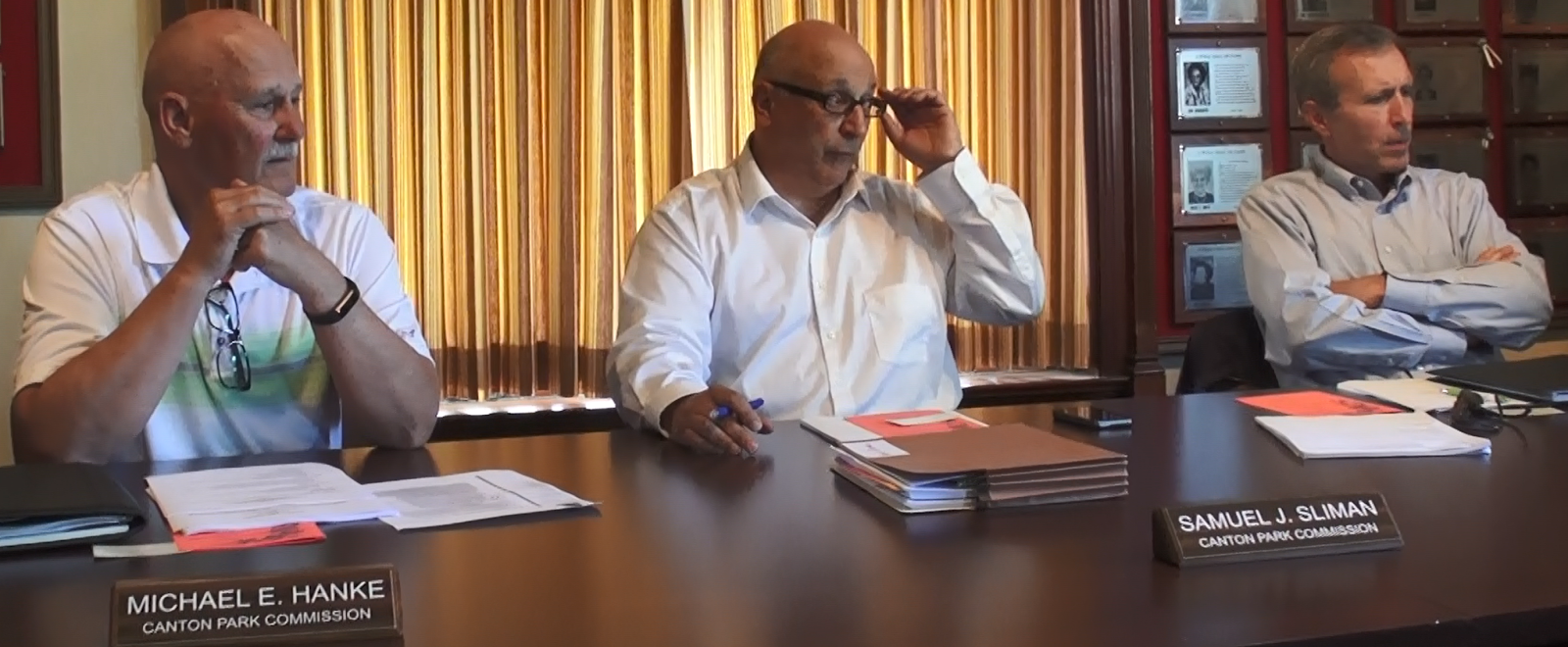
Perhaps coincidentally the change in Coleman management from the current Central YMCA of Stark County to the JBSC is likely to occur on January 1, 2017, the projected date that the Canton Parks Commission (CPC) and the Canton Joint Recreation District (CJRD) will merge into one entity that being the CPC.
Consequently, the direction going forward on:
how the CPC will change its focus on parks and recreation matters for city of Canton residents and, of course, other Stark Countians who use Canton's park and recreation programs and facilities will be made by Canton Parks Commission and its board members Andy Black, Mike Hanke and Sam Sliman, and
the management of Coleman
will likely be made by the CPC board (Andy Black, Mike Hanke and Sam Sliman) at its August 10th meeting.
A impetus for the Coleman management change is for Canton to have greater control in harvesting data on the operation of Coleman and the JBSC and thereby qualify for grants that will allow for fiscal support that portends increased financial stability for the operation of both facilities.
While the idea is that Coleman and the JBSC operations (remembering that the JBSC facility ownership wise is independent of Canton government) will mirror one another in overall programming and operation; aspirationally, individual unique factors to each are set to survive into joint management.
Progress on getting Coleman up to J. Babe Stern Community Center standards might have happened some time ago were it not for the hostility of former mayor William J. Healy, II towards the JBSC.
On a ironic note, one of the foremost promoters of the JBSC has been Ward 5 councilman Kevin Fisher, who, like Smith (Ward 4) is waiting for more information before commenting on the projected change of Coleman's management, was also one of the hard core council supporters of the Healy administration.
A quote by Fisher on JBSC: "... a long successful history of managing a community center in the heart of the SW end ..." It appears to the SCPR that such is the sentiment of the Mayor Thomas M. Bernabei administration and it is pretty much a "no doubter" that come January 1, 2017 Coleman will be under "new" management.
Copies of Canton's contracts with Central YMCA of Stark County on Coleman followed by a copy of the contract of Canton with the JBSC.
CANTON/YMCA RE: COLEMAN
CANTON/JBSC
GORDON EMAIL ON DIFFERENCES
Martin,
I have included the drawdown sheets from 2015 and 2016 for the JBSC as well as the 2015 Annual Report which has all of the expenses for both buildings(See 401045 and 401040 line items).
I can also tell you that we have spent nearly $35,000 YTD on the 2016 YMCA contract at the Edward "Peel" Coleman Center. We typically do not pay the YMCA the full annual amount of their contract as they collect the revenues received at the building for various user costs and deduct this amount from our bill on a monthly basis.
The reason for the difference in overall expenses is building ownership. We provide reimbursable funds for the JBSC to operate their programs as they ultimately have their own board and non-profit distinction responsible for their building. The YMCA is not responsible for the Edward "Peel" Coleman Center building, just the programming as we own the building. We spend an additional $200,000 to $250,000 annually at the Edward "Peel" Coleman Center for all building maintenance, utilities, and other repairs and upkeep. Therefore, both buildings receive approximately the same amount of funding from the levy with the Edward "Peel" Coleman Center receiving slightly more given that we are ultimately responsible for all aspects of the facility.
In one of the sketchiest reports by a seasoned journalist the SCPR has ever read, Todd Porter of The Repository wrote yesterday that Republican presidential candidate Donald J. Trump is coming to Stark County.
Apparently the candidate of mostly "blue collar America" is planning, according to Porter, on hanging out with some of the bigs of Stark County (the Timkens, of course) for big bucks for the Republican National Committee (NRC) and perhaps a few for himself at one of if not THE POSHEST country club in Stark County (Brookside).
The price of admission is $25,000 per person if that person wants in on:
a private dinner,
a reception, and
a photo op
with—in his own mind—the greatest American politician ever!
Looking at the Federal Election Commission rules of campaign contribution, it must be that the $25,000 per pop will not be—in the direct sense—to the Trump campaign.
One of the donation levels Porter reported as being the minimum for the Trump event was $2,700 which just happens to be the maximum that an individual can contribute to a federal office candidate in the current general election cycle.
Yesterday, a huge fissure broke open between Trump and U.S. Speaker of the House Paul Ryan and U.S. Senator John McCain, stalwart Republicans in top tier standing with the NRC, as Trump put into question whether or not he would endorse them in respective upcoming primary elections.
And who can forget Trump's campaign manager Manafort bashing Governor John Kasich for refusing to endorse Trump and not showing up at the RNC convention at nearby Cleveland in mid-July.
Smith in other years would "win in a walk." Democrat Steve Slesnick's hope for election lies in a solid Hillary Clinton win in Stark and coattails strong enough and long enough for him to squeak through.
Kasich says that being off the Trump bandwagon means he will be campaigning for local candidates.
Smith and Jakmides certainly ought to take him up on his word. He could be a refuge for them should Clinton win handily in Ohio and Stark County.
Should Trump win in November, the Republican Party as we know it is finished. Without a doubt, the $25,000 will go towards remaking the Grand Old Party in the image of the name calling Trump.
The SCPR thinks a Trump win is unlikely based on Five Thirty Eight statistician Nate Silver saying that Democrat Hillary Clinton has about an 80% chance of winning.
Silver has been almost flawless in recent presidential elections.
But he is careful to say that Trump could win.
As we all know, Trump is doing everything he possibly can to make that "could" into being "Slim" with "Slim having just left town."
It is safe to presume that Stark County Republican vice president Jane Timken and her husband Tim will be ponying up $25,000 each, but the question is what other Stark Countians will be following suit.
The private dinner might just be Donald, Tim and Jane, no?
Just kidding.
Other hosts to Trump include Anthony Alexander (former FirstEnergy CEO), David W. Johnson, Steve Stokey and Bryan Williams.
How could a host and their respective "significant others" not buy a $25,000 ticket, no?
So rather than a "private dinner" at the posh Brookside being just Trump (will his wife be with him?) and the Timkens, perhaps, there will be up to a dozen.
Undoubtedly, the "private dinner" attendees list will be tried to be kept "hush, hush."
In due course, we will know. Because the FEC will list those contributions at the end of the month in which the event occurs.
At a $15,000 contribution, one gets to attend the reception and the photo op, but NO private dinner.
At the paltry $2,700 level (the cheapskates these contributors are), the reception is it. No private dinner. No photo op.
In the run up to the Republican primary election in Ohio, which he lost to Kasich, Trump needed a volunteer for him to have any presence in Stark County.
But for Ralph Case of Plain Township (LINK) who spent his own money to open a Stark County headquarters for Trump, the Republican nominee would have had no organization in Stark.
The Report has learned that Case was forced out for a time after the primary because the Trump national campaign people did not like his accessibility to the press.
At last report, Case was back because of a huge reaction the nationals got from other local Trump supporters.
In this SCPR cobbled together report (based on data provided by the FEC), Case was the first to contribute to Trump in Stark County, to wit:
Note that through June 30, the largest Trump contribution was $1,000 and the total through the 30th was $4,218.
Wow! $25,000, $15,000 and $2,700 for entry into the elegant Brookside and Trump's high according the the FEC through June was $1,000.
Does anybody think Case and others on the $4,128 list will get close enough to Brookside to smell the aroma from the undoubtedly opulent meal served at "the private dinner?"
Ron Ponder Opens Forum ===========================
Mayor Thomas Bernabei Introductory Remarks ===========================
Officer Lemar Sharpe Community Relations
===========================
Officer William Watkins Community Interactions
===========================
Former Officer Bruce Allison Security & Community Interaction
===========================
Wrap Up Interview: Mayor Bernabei
Thursday last, the Mayor Thomas M. Bernabei administration endeavored to show "how on the ball" it is in putting together a series of community forums in which citizens can dialogue with city of Canton police (CPD) officials on relationships between the citizenry of the city and the police.
First in today's blog, WHBC's Ron Ponder, the able moderator of the event, sets up the agenda for the evening:
Next, Mayor Bernabei:
Of particular is the noting by Ponder in introducing Bernabei cited their first encounter when Ponder as then president of the Canton NAACP was part of a lawsuit against Canton (Bernabei then a Canton law department attorney) addressing deficiencies in minority hiring at the time within the CPD.
All of this, of course, in light of police/community hostile even murderous interactions in Cleveland, Baltimore, Baton Rouge and Dallas to name just a few of the many, many encounters that occur across the American landscape daily.
As this blog is written, Canton's SWAT operation is the subject of a lawsuit which the city says is meritless that only WKYC television and the SCPR has dealt with (SCPR blog LINK).
Local attorney and civic activist Craig T. Conley has been pressing for an objective forum (Ohio attorney general and the U.S. Department of Justice) in which to have the actions of the Canton SWAT team leadership scrutinized in terms of assessing whether or not a Massillon homocide was justified.
Conley and WKYC are suggesting, perhaps, that there was a cover up on the part of a local investigation of the matter.
The SCPR estimates that perhaps as many as 150 citizens showed up for Thursday's session.
Canton seeks to get out in front of the "can be" volatile police/citizen encounters and thereby prevent Baton Rouges and Dallases from becoming headlines in Stark County or possibly national media.
Accordingly, city officials headed by Mayor Bernabei working with community organizations and entities created the Thursday event.
All-in-all, it was a informative initiate.
However, there were several glaring weaknesses.
There was not enough Q&A time which seemingly was stuffed in at the end of the forum thereby giving short-shrift:
About fifteen minutes in a approximately two hour program?
"Give me a break!, no?"
A roving microphone should have been made available to questioners so that there could be a back and forth.
There were several occasions in which the usually and certainly on this occasion masterful moderator Ron Ponder (Points to Ponder, WHBC) wanted to follow up on a written question but was stymied by the overall construct of the Q&A part of the session,
Not of enough time was spent candidly addressing current police/community troubles which could mushroom into a "we have a problem" of great magnitude on the ignition a spark seemingly coming out of nowhere,
One person attending the event described to the SCPR an alarming story of how a current African-American citizen of Canton has apparently be subjected to four racial-profiling contacts with the CPD in recent times.
But not a word of these incidents or others of similar ilk came out at the forum,
Only a vague, generalized acknowledgement that the CPD is not perfect and has personnel problems to deal with,
Of course, one needs to remember Bernabei's point that the July 28th forum is just "the beginning" of a continuing dialogue between the community and police.
Although the focus on these community/policing events is on Canton and its citizenry, the quality of community/police relations in Canton is relevant to anybody who has occasion to be in the city of Canton whatever the occasion.
The highlight of the evening was the appearance of retired captain Bruce Allison of the CPD. Bruce served as a Pro Football Hall of Fame city policeman in days that it was truly a test of courage and fortitude to be a black police officer in an overwhelmingly lily white police department.
Cantonians should take in this absorbing account by Allison from his days as a member of the Canton Police Department which was clearly a frightening and scary is experience requiring a lot of courage which in the SCPR's book makes Allison a heroic figure.
Then there was Lemar Sharpe speaking about community relations.
Sharpe has been with the CPD since May, 2001.
He is one of 132 "on the beat" police officers that staff the Canton Police Department at an average salary of $50,645.70 according to payroll figures provided by Canton's finance director in response to a SCPR public records request in July. While $50,000 plus is a decent income to many, one has to remember that these folks put their lives on the line each and every day.
Highlights of the following Sharpe video include:
His love of living in one of Canton toughest neighborhoods in terms of crime rate and poverty (re poverty: about 40% accordingly to a recent Canton Comprehensive Plan consultant survey) and his engagement with his neighbors,
His candid admission of his disillusion with the recent happenings in the nation regarding the interaction between police and the African-American community and his determination to work hard to change the negative aspects of the relationship,
His adventurous (i.e. how will the police hierarchy react) use of social media in reaching out to the Canton community in the furtherance of attaining a solid police/community relations in which "snitching" is not viewed as a "no-no,"
The Officer Sharpe video:
Right before Sharpe spoke, Lt. Greg Boudreaux spoke about "Training, K-9 Training, Body Cameras, & Use of Force." A poignant point was made by moderator Ponder on how the black community was at one time skeptical if not hostile to the use of dogs in police work.
Be sure to watch this short video snippet.
Next up was Canton PD officer William Watkins who has been with the department since 1998.
Watkins: (raised in northeast Canton)
Talked about joint effort of the CPD and the Canton NAACP (about six months in duration so far) in which the focus is on teens and young adults who live in Canton,
Described CPD interactions designed to focus on avoiding arrests by directing citizens to sources within the Stark County community to help them solve their particular problems,
Shared some startling statistics about number of police officers killed in the past two years in the-line-of-duty and number of guns possessed by 300 million plus Americans,
Pinpointed the dangers of being a police officer beginning with the commonplace police officer function of making traffic stops interacting with persons who have reason not to want to interact with a police officer,
Described a primary function of his work in schooling kids on how to interact successfully with police officers,
Provided resources to citizens who has had an unsatisfactory experience with a Canton police officer,
The Watkins video:
Also appearing at the forum was trailblazing for African-American police officers in Canton: Bruce Allison.
This video is a "must watch" for readers of the SCPR to get some measure of what it was like to be a minority CPD member "in the day."
Finally, here a a video of a "wrap up" SCPR interview with Mayor Bernabei.
)
In conclusion, The Report hails the likes of Sharpe, Watkins and Allison in being on the front lines as first-rate examples of minority police officers who are the vanguard the promise of improving police/community relationship.
For this contribution in and of itself these officers deserve be be thought of as heroic.
Each as officers enforcing the law have always had to deal with the potential of being subjected to harm as they perform there day-in, day-out jobs as police officers.
With their current focus on bringing local citizens on board in these trying times of a somewhat chaotic models across the nation of community/police relationship, they are even the more heroic in the eyes of the SCPR.
WILL CANTON'S TEACHERS BE VOTING ON A NEW CONTRACT TODAY?
These are absolutely critical times for the Canton City Schools (CCS).
In a little over two weeks, the students who live in Stark County's county seat will be filing into the buildings of the CCS questing for "a brighter tomorrow."
The question: Is there "a brighter tomorrow" for the CCS or is it all "doom and gloom?"
The SCPR has seen the answer as being "doom and gloom.
Witness a November, 2013 blog on the Rinaldi/Resnick face-off (LINK) and this chart from the Ohio Department of Education in a recent SCPR blogs LINK).
That is until the SCPR learned that once bitter political enemies and Canton City Schools Board of Education (CCS-BOE, BOE, District) J.R. Rinaldi and Eric Resnick have more or less reconciled their differences and have agreed to set them aside in their joint mission to provide the essential leadership to reverse CCS slide into an academic abyss.
The Report has learned that CCS officials have in hand a similar chart that, while currently in preliminary stages, it is said to show a continuing dire situation in the quality of education in the CCS top to bottom.
Moreover, there are reports that there have been protracted and tense negotiations between the Canton Professional Educators Association and the CCS on a new contract for the teaching staff with the school system. An unconfirmed (with CPEA/school officials) report has the CPEA voting on a new contract today.
The Report is told that the CPEA has a particularly bitter take on Superintendent Adrian Allison and want him gone.
Because of Resnick and Rinaldi's "we are together" leadership model, it appears that the CPEA is prepared to put its opposition on the back burner and agree to a new contract.
School starts in a little over two weeks.
Unless he decides otherwise, Allison will be continuing with the CCS for School Year 2016/2017.
Take a look at his current contract:
Allison has been on the job since January 1, 2013 and by contract has a right to continue as CCS superintendent until July 31, 2013 which in essence means one more school year after this school year.
The Report believes that might well be a move initiated perhaps as early as February, 2017 to explore the feasibility of Allison agreeing to a termination of his relationship with CCS prior to the beginning of the 2017/2018 school year.
One unhappiness with Allison reportedly is that he keeps bringing forth models of education that will not work in an urban school such as the CCS.
In addition to the reported CPEA dissatisfaction with Allison, the inadequacy of a workable educational model for Canton's schools, he has a historically poor relationship with BOE member Resnick (likely beginning with the Timken/McKinley merger flap [LINK] and The Report thinks that it might be in Resnick's mind that the best thing going forward is for Allison to move on.
The Report has not talked with Resnick and the foregoing is conjecture by the SCPR based on past animosities that Resnick has directed at Allison.
A CCS connected person in a position to know says that the chief reason for hope for the system going forward is a rebuilding of the CCS education infrastructure beginning in the primary grades (a process said to be already underway).
Cantonians ought to hoping and praying that the Resnick/Rinaldi coming together and the "rebuilding the basics of fundamentally sound education" is the "real deal" in Canton, for if it is not, there could be a absolutely horrible immediate future for Canton's schools.
And the consequences to Canton in general without a viable plan to dramatically improve Canton schools will be far reaching.
Canton has elected a new mayor (politically independent Thomas M. Bernabei) who is already making dramatic improvements in the fundamental financial base of Canton government.
Moreover, he is working through the city's building department (principally Rinaldi) to reconstruct those neighborhoods of Canton that can be turned positive and be an attraction to younger families as being a desirable place to nurture family life.
But all this work will lilely be for naught if the Canton schools are not improved dramatically over the next ten years.
One reader of the SCPR thinks that Canton might be in for an immediate future (meaning one more year to turn things around) akin to the Cleveland, Lorain and Youngstown schools wherein the Canton schools become mired in what is nominated as being the Academic Distress Commission, to wit:
Is it possible that the Canton City Schools will suffer the same fate as the Youngstown School District and be placed under state supervision soon? The latest data will be released soon and the numbers for Canton City Schools do not look good. In fact Canton is in about as bad shape as the Cleveland City School District and other distressed school districts like Lorain City Schools. You may recall that the State of Ohio passed legislation (HB 70) which allowed the state to takeover the Youngstown Schools. HB70 provides for the state superintendent to make three appointments, the mayor of the city to make one appointment, and the president of the school board to make the last appointment. The all powerful position of Chief Executive Officer is appointment by the Academic Distress Commission. You may also recall that this legislation was past quickly and without much fanfare and passed as an effort to "rescue" the Youngstown Schools.
As an overview, here is how the process works.
The Academic Distress Commission is a joint school district and state panel that steps in to try to fix the schools. The determination of which school is taken over is as follows: Previous state law called for state takeover of districts rated in "academic emergency," the equivalent of an overall F grade on state report cards for three years in a row, and who miss a few other standards under the federal No Child Left Behind law. Because the state's not giving districts overall grades right now, three years of F grades on the Performance Index measurement of student achievement and a grade of D or F for the value-added measure of student academic progress would also trigger state takeover. The new bill makes only slight adjustments to these rules. Districts Currently Affected: Both the Lorain and Youngstown school districts have Academic Distress Commissions running their schools, but only Youngstown was affected by HB 70 - for 2015 to 2016 school year. If Lorain's grades do not improve, a new Academic Distress Commission with new powers could be created for the 2017-18 school year. Any new districts declared as failing will be handled under the new rules. Bill changes panel membership: Before this bill, the state superintendent would appoint three people to this five-member panel. The local school board president would appoint two. HB 70 would still let the state superintendent approve three members, but requires one of them to be from the district's county. The school board president appoints one member, who must be a teacher and the mayor appoints the fifth. New CEO would take most of the control: The panel and the school board already in place in the district would give most of its power to a new CEO to be paid between $150,000 and $200,000 a year by the state. Duties would include, as described by the the legislature's non-partisan research arm: (1) Replacing school administrators and central office staff; (2) Assigning employees to schools and approving transfers; (3) Hiring new employees; (4) Defining employee responsibilities and job descriptions; (5) Establishing employee compensation; (6) Allocating teacher class loads; (7) Conducting employee evaluations; (8) Making reductions in staff; (9) Setting the school calendar; (10) Creating a budget for the district; (11) Contracting for services for the district; (12) Modifying policies and procedures established by the district board; (13) Establishing grade configurations of schools; (14) Determining the school curriculum; (15) Selecting instructional materials and assessments; (16) Setting class sizes; and (17) Providing for staff professional development. CEO can close struggling schools: By year two of the Commission being named, the CEO can close struggling schools, impose a turnaround plan or convert the school to a charter school. CEO can change union contracts: By year three, the CEO can change or suspend any rules in place in union contracts, so long as they do not lower the pay and benefits of employees. School board appointed by mayor, not elected: By year five, school board members will be appointed by the mayor, not elected. There will be no vote by the community to make this change, as occurred in Cleveland when it shifted to a mayorally-appointed board. The community will have a vote to return to election its school board once the district is no longer considered as "failing." Panel and CEO will also add more charter schools: The bill calls for adding more "high quality" school choices in the district for families and creating a panel to act as a "high quality school accelerator" to improve schools and add more choices faster. The legislative comments state: "The accelerator's role is to promote "high-quality" schools in the district, lead improvement efforts for underperforming schools not operated by the district, recruit "high-quality" sponsors for community school, attract new "high-quality" schools to the district, and increase the overall capacity of schools to deliver a "high-quality" education for students." CEO will create a community advisory panel: The CEO must create a panel of community advisors to help create a new plan for the district. The commentary to the legislation further states: "The purpose of the group is to develop expectations for academic improvement in the district and to assist the district in building relationships with organizations in the community that can provide needed services to students. The members of the group must include at least educators, civic and business leaders, and representatives of institutions of higher education and government service agencies." State Funding: The state can give the district up to $1.5 million as a one-time payment to enact its plan.
With regard to the Youngstown Schools, the 2015 results of this state takeover of the Youngstown Schools will be apparent once the data for last year is presented in the forthcoming weeks. At that time we will also know if Canton Schools will be on to a "Brighter Tomorrow" or to State Supervision.
The SCPR for one hopes that the apparent "coming together" of former BOE rivals Resnick and Rinaldi for the sake of the well-being of the Canton schools will be effective to stave off what may be in the offing for Canton schools (i.e. Academic Distress Commission supervision).
Such a development would certainly impede Canton's municipal government in its effort to get the city healthy again.
Many area citizens and Stark County political subdivision (elected and appointed) officials think that the Pro Football Hall of Fame Village Project (HOFVP)—if it materializes—will be "the salvation of Canton."
While all should hope and pray that the HOFVP becomes a reality, it will not be a panacea solution to the decades in the making problem of the eighth largest city of Ohio.
It will be the work of Canton's strong neighborhood association network, responsible landlords (e.g. Kings Landing LINK) coordinating with the schools and the Bernabei administration that will "tell the tale" of the future of a town that is the birthplace of a president of the United States.
B.A. - Political Science
J.D.
AN INDEPENDENT MINDED POLITICAL COMMENTATOR
Until 1976 I was a Republican. Since then I have considered myself a Democrat. So after long term stints of being a Republican, then a Democrat, I have come to the political position I feel most comfortable with - being an INDEPENDENT MINDED ANALYST who demands effectiveness of our politicians - Republican, Democrat or whatever.
I have changed my political affiliation to "non-partisan" by not voting in either political party primary election.